Dual-Mode Bluetooth: Classic/BLE Coexistence
Dual-mode Bluetooth stands out as a crucial technology for the Internet of Things (IoT) era, seamlessly integrating classic Bluetooth and Bluetooth Low Energy (BLE).
By Mike Ulanski
Published on July 9, 2024
Bluetooth technology has seen substantial advancements over the years, evolving from Bluetooth 1.0 to the current Bluetooth 5, and these improvements have enabled Bluetooth to become an integral part of a variety of commercial and consumer applications. During that time, the original Bluetooth protocol (Now called Bluetooth Classic) gained a counterpart: Bluetooth Low Energy. The two operate on the same frequency range, but in completely different ways, with Bluetooth Low Energy (as its name implies) using much less power. Shortly after the release of Bluetooth Low Energy, some devices began utilizing dual-mode bluetooth, which combines the strengths of classic Bluetooth and BLE on the same device.
Dual-mode Bluetooth stands out as a crucial technology for the Internet of Things (IoT) era, seamlessly integrating classic Bluetooth and Bluetooth Low Energy (BLE). This dual-mode capability is essential for IoT devices that require both high-throughput data streaming and low-power connectivity, offering a versatile solution that meets the diverse needs of modern wireless communication.
Evolution of Bluetooth Technology
Since its introduction in 1999, Bluetooth technology has seen numerous iterations and advances.
- Bluetooth 1.0/1.1 (1999–2001): The first public versions of Bluetooth focused on basic wireless connectivity for personal devices. Version 1.1 (2001) introduced device pairing and improved interoperability.
- Bluetooth 2.0 + EDR (2004): Added Enhanced Data Rate (EDR), boosting maximum data rate to about 3 Mb/s for faster data transfer . This era saw Bluetooth becoming common in phones, headsets, and PCs.
- Bluetooth 2.1 (2007): Introduced Secure Simple Pairing (SSP) for better security and easier user pairing experience .
- Bluetooth 3.0 + HS (2009): Included a High Speed (HS) mode using Wi-Fi (802.11) radios to reach data rates up to 24 Mb/s . This allowed bulk data transfer (e.g. media files) by temporarily utilizing Wi-Fi alongside Bluetooth.
- Bluetooth 4.0 (2010): A breakthrough release that introduced Bluetooth Low Energy (BLE) as an officially integrated part of the specification . Classic Bluetooth (sometimes called BR/EDR for Basic Rate/Enhanced Data Rate) remained for high throughput, while BLE was added for ultra-lowpower, low-bandwidth applications. This was the origin of dual-mode capability: the Bluetooth 4.0 spec allows devices to implement both BLE and BR/EDR in a single device , laying the groundwork for dual-mode Bluetooth.
- Bluetooth 4.1 & 4.2 (2013–2014): Brought incremental improvements such as better coexistence with other wireless tech, increased packet capacity, and enhanced range. These versions refined how Bluetooth plays nicely in crowded 2.4 GHz environments (e.g. improving adaptive frequency hopping to reduce Wi-Fi interference).
- Bluetooth 5.0 (2016): Significantly expanded BLE capabilities. It doubled BLE speed (2 Mb/s PHY), quadrupled BLE range (with new low-rate coded PHY), and increased broadcasting capacity eightfold. Classic Bluetooth remained largely unchanged in speed, but the overall Bluetooth 5 specification made BLE far more versatile for IoT — enabling longer-range connections and higher throughputs on the low-energy side.
- Bluetooth 5.1, 5.2, 5.3 (2019–2023): Continued to enhance BLE with features like direction finding (for location services), isochronous channels for LE Audio, improved security, and more. Notably, Bluetooth 5.2 introduced LE Audio, which allows high-quality audio streaming over BLE, potentially shifting some audio use cases to Low Energy mode in the future. Classic Bluetooth (BR/EDR) remains in the spec for backward compatibility and use cases like legacy audio, but many new features focus on BLE advancements.
What Is Dual-Mode Bluetooth
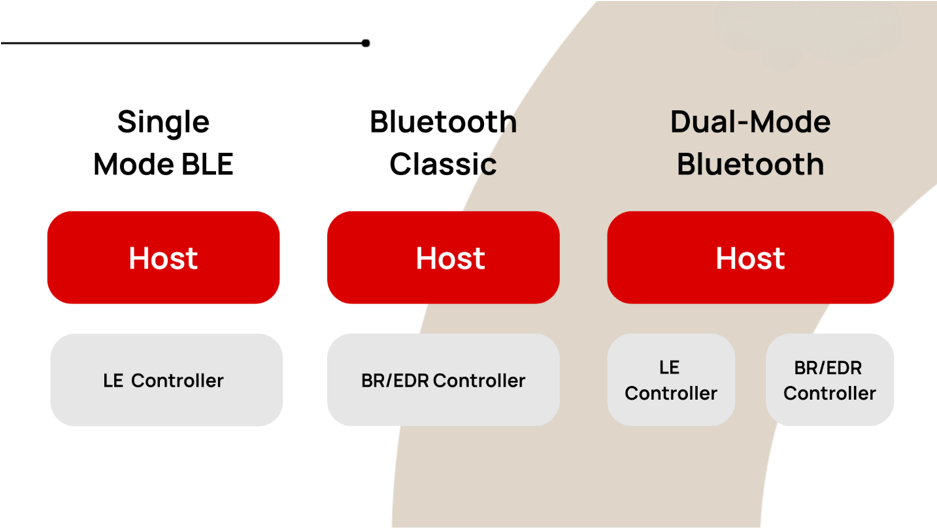
Dual-mode Bluetooth refers to the coexistence of classic Bluetooth (often called Bluetooth BR/EDR) and Bluetooth Low Energy (BLE) in a single device. Classic Bluetooth, used in applications like wireless audio streaming, provides high throughput but consumes significant power. In contrast, BLE is designed for low power consumption and is ideal for IoT devices that periodically transmit small amounts of data, such as sensors.
In a dual-mode device, the Bluetooth controller and host stack are designed to handle both BLE and Classic. The coexistence of the two protocols is managed intelligently: - Adaptive Use of Classic vs BLE: The devicewill use Classic Bluetooth for tasks that need high throughput or legacy profile support, and use BLE for tasks that can be done with low energy consumption. For example, a dual-mode smartphone may use Classic BR/EDR to stream audio to your wireless headphones, while simultaneously using BLE to sync with a fitness band or send data to a BLE sensor . The user doesn’t have to think about this – the system automatically engages the appropriate mode for each connection.
- Parallel Operation: Dual-mode devices can maintain Classic and BLE connections at the same time. A phone could be on a voice call via a Classic Bluetooth car kit, and at the same time be receiving heart rate data from a BLE chest strap. The Bluetooth stack schedules these activities so that the radio transceiver hops between the Classic link and BLE link without them interfering. Technically, the device performs a form of time-division multiplexing to share the 2.4 GHz radio channel between Classic and BLE activities . Classic Bluetooth already divides time into slots for its frequency hopping, and BLE has its own interval timing; a dual-mode controller coordinates these, rapidly alternating so both protocols get airtime. This time-sharing mechanism is what allows dual mode chips to serve both Classic and BLE virtually concurrently.
- Shared Hardware: Because both Classic and BLE operate in the same 2.402–2.480 GHz ISM band, a dual-mode device can use a single radio antenna and much of the same RF front-end for both protocols . The modulation schemes differ (Classic uses variations of Gaussian FSK and PSK, BLE uses a simpler GFSK), but chip designers integrate support for both in the radio silicon. This hardware sharing makes dual-mode more cost-effective and compact than having two separate radios. Essentially, a dual-mode Bluetooth chip is like having two Bluetooth radios in one, with a unified control interface.
- Full Backward Compatibility: Dual-mode Bluetooth devices are backward compatible with older Bluetooth versions and devices. A dual-mode module that supports, say, Bluetooth 5 can connect to a Bluetooth 2.0 headset using Classic mode, or to a Bluetooth 4.0 sensor using BLE mode . This means users don’t have to worry about which “flavor” of Bluetooth their peripherals use – a dual-mode host will work with all. For product designers, this backward compatibility is a major benefit: a new dual-mode gadget can interact with the huge ecosystem of existing Bluetooth Classic devices (like speakers, cars, barcode scanners) as well as modern BLE devices, offering a universal connectivity solution.
- Use Case Flexibility: Because of the above, dual-mode Bluetooth enables use cases that wouldn’t be possible with a single-mode device alone. For instance, consider a pair of wireless headphones: using dual-mode, they might employ BLE for ultra-fast pairing and sending control commands (play/pause, battery status) efficiently, but switch to Classic A2DP mode for actually streaming the music in high quality . The user experiences this as one coherent Bluetooth connection, but under the hood both protocols played a role. In industrial or medical devices, dual-mode might allow a machine sensor to send bulk data or firmware updates over Classic, while using BLE for routine low-power telemetry in the background.
Dual-mode Bluetooth is crucial for IoT devices that require the flexibility to support high-throughput data transfer as well as low-power, long-range communication with sensors and peripherals.
Key Benefits of Dual-Mode Bluetooth
Dual-mode Bluetooth offers several key benefits by combining the capabilities of classic Bluetooth and BLE:
- Versatility: Devices with dual-mode Bluetooth can support a wide range of use cases, from high-throughput data streaming (e.g., audio) using classic Bluetooth to low-power, long-range communication with IoT sensors using BLE. This versatility enables manufacturers to create products that cater to diverse user needs.
- Enhanced user experience: Dual-mode Bluetooth enriches the user experience by leveraging the strengths of both technologies. For example, in wireless headphones, BLE can enable fast pairing and efficient media controls, while classic Bluetooth can be used for high-quality audio streaming. This combination provides users with a seamless, feature-rich experience.
- Power efficiency: By using BLE for low-data-rate tasks and classic Bluetooth for high-throughput applications, dual-mode Bluetooth optimizes power consumption, using higher power only when required. This is particularly beneficial for battery-powered IoT devices that need to conserve energy while maintaining functionality.
- Backward compatibility: Dual-mode Bluetooth devices are compatible with a vast ecosystem of existing Bluetooth-enabled products. This backward compatibility ensures that users can continue to use their older devices while enjoying the benefits of the latest Bluetooth technologies.
- Seamless Coexistence: Dual-mode Bluetooth devices can seamlessly switch between classic Bluetooth and BLE modes based on the application requirements. This seamless coexistence allows for efficient use of radio resources and minimizes interference, ensuring reliable performance in various environments.
- Future-Proofing: As Bluetooth technology continues to evolve, dual-mode Bluetooth ensures that devices can leverage the latest advancements in both classic Bluetooth and BLE. This future-proofing capability allows manufacturers to create products that remain relevant and competitive in the rapidly changing wireless communication landscape.
In summary, dual-mode Bluetooth offers significant benefits in terms of versatility, user experience, power efficiency, compatibility, connectivity, development costs, and future-proofing, making it an essential technology for a wide range of modern applications.
Dual-Mode BT Stack Architecture
Dual-mode Bluetooth devices incorporate both classic Bluetooth (BR/EDR) and Bluetooth Low Energy (BLE) protocols in a single chip, enabling seamless coexistence and communication between the two. The Bluetooth stack manages the coordination and switching between BR/EDR and BLE modes based on the application requirements.
In dual-mode operation, the device can function simultaneously as a host or client in BR/EDR connections and as a central or peripheral in BLE connections. The Bluetooth controller uses time-division multiplexing (TDM) to allocate time slots for each mode, ensuring efficient utilization of radio resources and minimizing interference.
When a dual-mode device establishes a connection, it first determines the required mode based on the application. For example, if the device needs to stream audio, it will use BR/EDR, whereas if it needs to communicate with a low-power sensor, it will use BLE. The Bluetooth stack then configures the controller to operate in the appropriate mode and manages the connection establishment and data transfer processes.
Dual-mode Bluetooth devices maintain backward compatibility with older Bluetooth versions, allowing them to connect with a wide range of existing products. For instance, a dual-mode Bluetooth 5.0 device can communicate with a Bluetooth 4.0 BLE device using the BLE mode, and with a Bluetooth 3.0 BR/EDR device using the classic Bluetooth mode. This compatibility ensures a seamless user experience and enables the coexistence of new and legacy devices in the same ecosystem.
Moreover, dual-mode Bluetooth devices can leverage the latest advancements in each protocol version. For example, a dual-mode Bluetooth 5.2 device can benefit from the increased speed, range, and broadcast capacity of Bluetooth 5.2 in BLE mode, while maintaining high-throughput data streaming capabilities in BR/EDR mode. This allows manufacturers to create products that harness the full potential of Bluetooth technology, offering enhanced performance and functionality to users.
Dual-Mode BT Use Cases
Dual-mode Bluetooth finds applications across various industries, leveraging its versatility to enable a wide range of use cases. Some of the most common applications include the following.
Industrial Automation and Asset Tracking (Industrial IoT)
In industrial settings, dual-mode Bluetooth plays a significant role in Industry 4.0 and smart factories. Many industrial IoT devices use BLE sensors for low-power data collection throughout a facility, combined with Classic Bluetooth for configuration or high-data transfers. For example, a machine sensor network might use BLE to regularly transmit temperature, vibration, or status data to a central gateway because BLE can support a large number of devices with minimal power draw. However, when it’s time to perform a firmware update on a sensor node or transmit a large log file, the system can switch to a Classic Bluetooth link (supported by the dual-mode radio) to take advantage of faster throughput. This dual-mode approach is used in wireless sensor networks, asset tracking tags, and machine-to-machine communications on the factory floor . It allows industrial devices to achieve extended battery life (by mostly using BLE) while still having the option for real-time control or bulk data transfer (via Classic) when needed. Additionally, many industrial handheld tools or diagnostic devices (like a maintenance tablet) are dual-mode so that they can connect to any equipment on site, whether the equipment’s wireless module is older BR/ EDR or newer BLE. The result is a more connected and efficient industrial environment, with reduced downtime and improved data visibility. Dual-mode Bluetooth’s robustness (frequency hopping and error correction) also helps in noisy RF environments like factories.
Healthcare and Medical Devices
Medical devices have widely adopted Bluetooth for cable replacement and patient monitoring – and increasingly, they rely on dual-mode capabilities. For instance, a hospital vital signs monitor might connect to various BLE-based wearable sensors on a patient (blood pressure cuffs, glucose monitors, heart rate straps) to gather data at regular intervals. BLE is perfect here because these sensors can operate for days or weeks on battery and still report frequently. At the same time, that monitor might need to stream high resolution data or waveforms to a central system or to a doctor’s tablet for real-time observation. Dualmode allows it to maintain BLE links with sensors and a Classic Bluetooth link for a high-bandwidth data stream or perhaps an audio channel (e.g., sending an alarm to a nurse’s headset). We also see dual-mode in consumer medical and fitness devices: for example, a glucose monitor that sends periodic low-power readings to your phone via BLE but can also use Classic SPP to communicate with an older insulin pump device. In telemedicine or remote patient monitoring, BLE wearable sensors send data to a smartphone, which then might use Classic Bluetooth to interface with a legacy device or simply use BLE for all – the phone being dual-mode guarantees it can interface with all the necessary devices. Additionally, some medical devices use Classic for certified profiles like HDP (Health Device Profile) and BLE for newer standards; a dualmode radio can handle both as needed. Overall, dual-mode Bluetooth in healthcare enables continuous monitoring with minimal battery impact and ensures compatibility with hospital equipment and mobile devices across different Bluetooth generations . This improves patient mobility (less wires), data accuracy (direct wireless feeds of vitals), and makes it easier for medical staff to set up devices without worrying about compatibility.
Automotive and Transportation
Modern vehicles are packed with wireless technologies, and dual-mode Bluetooth is a key enabler in the automotive space. In cars, Classic Bluetooth has long been used for hands-free calling and audio streaming (A2DP for music to the car stereo), providing reliable high-quality audio. Now, BLE is being integrated for new features like keyless entry and sensors. For example, some vehicles use BLE for detecting proximity of a key fob or smartphone (to unlock doors or enable push-button start) because BLE can advertise periodically with very low power – ideal for a key fob that runs on a coin cell. Dual-mode allows the car’s infotainment system to handle those BLE signals and simultaneously maintain Classic connections for phone calls or music. Additionally, BLE might be used in tire pressure monitoring systems or other in-car sensor networks that need to conserve battery, whereas Classic might be used when the car uploads diagnostic data to a service tool at the dealership. Many automotive infotainment units and aftermarket head units are dual-mode so they can pair with any phone: if the phone supports the latest BLE-based phone-as-a-key standard, the car can use it; if not, it can use older methods. Telematics devices and fleet trackers may use BLE to communicate with various cargo or environmental sensors in a truck, while using Classic to tether to a driver’s phone for data uplink. The automotive use of dual-mode Bluetooth exemplifies how it provides a smooth user experience – your car seamlessly connects for both low-power background tasks and high-data uses like audio, without you needing to manage different radios . This results in features like improved battery life on peripheral devices (fobs, sensors) and enhanced capabilities in vehicles (like simultaneously connecting multiple devices or types of devices).
Consumer Electronics (Smartphones, Tablets, PCs)
The consumer electronics category is perhaps the most obvious domain for dual-mode Bluetooth, simply because virtually every smartphone, tablet, and laptop today comes with a dual-mode Bluetooth radio. This lets these gadgets act as universal hubs for myriad accessories. A smartphone, for instance, can stream music to a wireless speaker via Classic Bluetooth while also syncing with a smartwatch via BLE. It might also be connected to a BLE fitness tracker, a BLE heart monitor, and a Classic Bluetooth car kit all at once. Dual-mode in phones and tablets means users don’t need to know what type of Bluetooth their accessory uses – it will just work. Beyond phones, consider laptops and desktop PCs: many offer dual-mode Bluetooth so that one can use BLE-only devices (like newer wireless mice/keyboards that favor BLE for battery life) as well as older devices (like an old Bluetooth 2.0 serial gadget or presentation clicker). Gaming consoles and VR headsets also often include dual-mode Bluetooth to support both BLE peripherals (e.g. low-power controllers or sensors) and Classic audio (e.g. connecting to Bluetooth headphones using standard audio profiles). In the smart home, tablets or smart hubs with dual-mode can communicate with BLE beacons and sensors around the house while still supporting classic devices. The consumer space benefits from dual-mode mainly through convenience and compatibility – it provides a one-size-fits-all wireless link. Users can add new BLE-based gadgets (which might have better battery life) without losing support for their existing Bluetooth gear. This has helped drive the adoption of BLE in consumer gadgets because the phones and PCs were ready to talk to them, thanks to dual-mode chipsets.
Wearables and Smart Devices
Wearable technology like smartwatches, fitness bands, AR/VR glasses, and health trackers rely heavily on Bluetooth, and many are dual-mode to maximize their functionality. A smartwatch, for instance, might use BLE to stay connected to your phone all day long for notifications and health data sync, since BLE can keep a link with minimal battery impact on both watch and phone. However, that same smartwatch might switch to Classic Bluetooth if you decide to stream music from the watch to some Bluetooth earbuds (some smartwatches have music storage and can act as a music source). If those earbuds don’t yet support BLE Audio, the watch’s dual-mode radio will use Classic to send audio. Similarly, a smartwatch might use Classic Bluetooth when interfacing with certain gym equipment or older Bluetooth devices, while using BLE for most of its regular duties. Another example is Bluetooth earbuds/headsets themselves: many new earbuds use BLE for the initial pairing process (via something like Apple’s W1/Apple Watch or Google Fast Pair protocols that often use BLE) and then Classic for the actual audio stream. Some advanced wearable devices, like high-end AR headsets, could use Classic for streaming video/audio data and BLE for control/ data sync concurrently. Dual-mode Bluetooth empowers wearables to provide rich features without sacrificing battery life. They can maintain a continuous low-power link to a host (so you get real-time updates), and they can still perform high-data transfers when needed (like syncing music or large datasets) by invoking Classic mode. This dual capability has been pivotal in wearables because these devices are extremely power-sensitive but also expected to handle more data over time. As BLE continues to improve in throughput (and with the advent of LE Audio), wearables might lean more on BLE, but having Classic in their arsenal ensures maximum compatibility with all phones and accessories during this transition period.
The ability of dual-mode Bluetooth to support a wide range of applications across various industries underscores its significance as a versatile and future-proof wireless technology. As the IoT ecosystem continues to evolve, dual-mode Bluetooth will play an increasingly crucial role in enabling seamless connectivity, enhancing user experiences, and driving innovation across sectors.
Dual-Mode BT Design Challenges
While dual-mode Bluetooth offers numerous benefits, implementing it in devices can present several challenges and considerations:
- Complexity in design and development: Integrating both classic Bluetooth and BLE in a single device requires careful design and development efforts. Developers must ensure seamless coexistence and coordination between the two modes, which can be complex due to differences in their protocols, data rates, and power requirements. To overcome this challenge, developers can leverage pre-certified dual-mode Bluetooth modules and software development kits (SDKs) that simplify the integration process and reduce time-to-market.
- Ensuring backward compatibility: Dual-mode Bluetooth devices must maintain compatibility with a wide range of existing Bluetooth-enabled products to provide a seamless user experience. This requires thorough testing and validation to ensure that the device can communicate effectively with older Bluetooth versions in both classic and BLE modes. Developers can use Bluetooth qualification tools and interoperability testing services to verify compatibility and resolve any issues.
- Managing power consumption: Optimizing power consumption is crucial for battery-operated dual-mode Bluetooth devices, particularly those that rely on BLE for extended battery life. Developers must carefully manage the switching between classic Bluetooth and BLE modes, as well as implement efficient power management techniques, such as sleep modes and low-power states. Using power-efficient Bluetooth chipsets, optimizing firmware, and employing energy-saving algorithms can help minimize power consumption and extend battery life.
- Coexistence with other wireless technologies: Dual-mode Bluetooth devices often operate in environments with other wireless technologies, such as Wi-Fi and Zigbee, which can lead to interference and performance degradation. To mitigate this issue, developers can implement coexistence mechanisms, such as adaptive frequency hopping (AFH) and time-division multiplexing (TDM), which help Bluetooth devices avoid interfering with other technologies. Additionally, using features such as LE Isochronous Channels (ISOC) and LE Audio, can further enhance coexistence and reduce interference.
- Security considerations: As dual-mode Bluetooth devices often handle sensitive data, such as personal information and health metrics, ensuring robust security is paramount. Developers must implement appropriate security measures, such as encryption, authentication, and secure pairing, to protect data transmission and prevent unauthorized access. Following Bluetooth SIG's security guidelines, using the latest Bluetooth security features, and regularly updating firmware can help safeguard dual-mode Bluetooth devices against potential vulnerabilities.
By addressing these challenges and considerations, developers can successfully implement dual-mode Bluetooth in their devices, enabling them to harness the full potential of this versatile wireless technology. As Bluetooth continues to evolve, new features and enhancements will further simplify the development process and help overcome the challenges associated with dual-mode Bluetooth implementation.
Dual-Mode BT: Versatility Unleashed
In conclusion, dual-mode Bluetooth has emerged as a crucial technology in the modern wireless landscape, enabling devices to leverage the strengths of both classic Bluetooth and Bluetooth Low Energy (BLE). By combining high-throughput data streaming capabilities with low-power, long-range communication, dual-mode Bluetooth empowers a wide array of applications across industries, from consumer electronics and wearables to automotive, healthcare, and industrial automation.
The coexistence of BR/EDR and BLE in a single device allows for versatile use cases, enhanced user experiences, power efficiency, and backward compatibility with existing Bluetooth ecosystems. However, implementing dual-mode Bluetooth presents challenges such as design complexity, ensuring compatibility, managing power consumption, coexistence with other wireless technologies, and security considerations. By leveraging pre-certified modules, SDKs, qualification tools, and following best practices, developers can overcome these challenges and successfully harness the potential of dual-mode Bluetooth in their products.
Ezurio (Laird Connectivity) has been at the forefront of Bluetooth technology and offers a range of Bluetooth modules and solutions to help developers harness this dual-mode power. From BLE-only modules to Classic-only solutions and full Classic + BLE dual-mode modules, Ezurio delivers hardware and support to cover all Bluetooth application needs . With deep expertise in wireless design, we assist in navigating the challenges of integration, ensuring your product achieves optimal connectivity performance and compliance. By partnering with an experienced provider and using well-designed modules, even small teams can quickly add dual-mode Bluetooth to their products and get to market faster.
In the end, dual-mode Bluetooth truly unleashes versatility. It’s a testament to how Bluetooth technology has evolved to meet modern demands: not by replacing the old with the new, but by combining them. This harmony between Classic and BLE widens the horizon for innovation. As you plan your next wireless project, consider the many advantages dual-mode Bluetooth can bring — it might just be the key to unlocking the full potential of your device in our increasingly connected world.