Getting Started
This guide documents how to quickly get up and running with Ezurio's Nitrogen8ULP SOM module and Nitrogen8ULP Carrier.
In the Box
The development kit contains the following item:
- 1x Nitrogen8ULP SOM
- 1x Nitrogen8ULP Carrier
On the Board
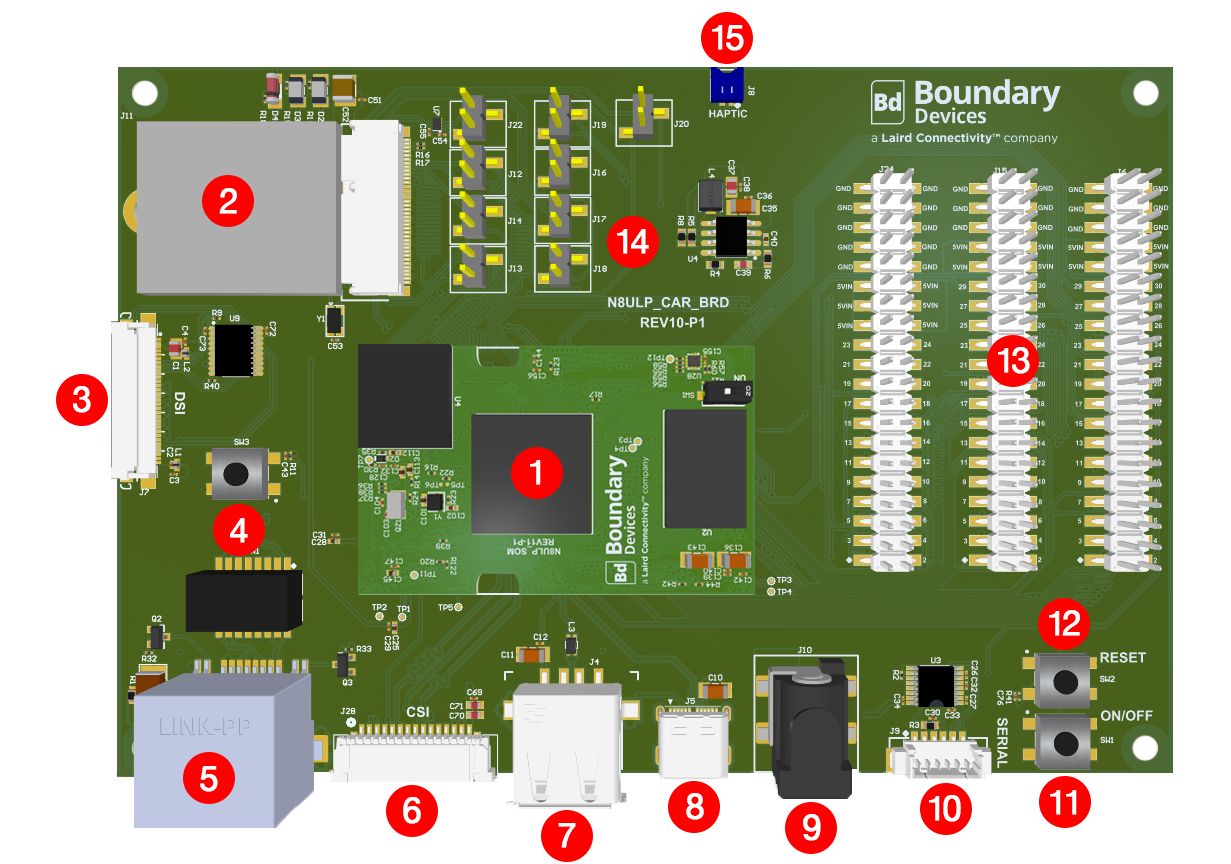
The Nitrogen8ULP SOM module and Nitrogen8ULP Carrier contains the following components and interfaces:

- Nitrogen8ULP SOM Module
- M.2 Connector (J11)
- DSI Display Connector (J7)
- PMIC_SYS_nRST Switch (SW3)
- Ethernet Connector (J21)
- CSI(2-lane) Connector (J28)
- 1x USB-A 2.0 Port (J4)
- High-Speed USB-C OTG Connector (J5)
- Barrel Plug Power Adapter (J10)
- 6 Pin Molex Connector for Serial (J9)
- On/Off Switch (SW1)
- Reset Switch (SW2)
- 3x Expansion Connectors (J24, J15, J6)
- 9x Expansion Connectors (J22, J12, J14, J13, J19, J16, J17, J18, J20)
- Haptic (J8)
Board Assembly
The Nitrogen8ULP SOM module and Nitrogen8ULP Carrier arrive disassembled. In order to assemble, you will need to install the Nitrogen8ULP SOM module onto the Nitrogen8ULP Carrier.
To assemble, complete the following steps:
-
Align the Nitrogen8ULP SOM module onto J1, J2, and J3 connectors of the Nitrogen8ULP Carrier.
-
Once aligned, press down firmly on the Nitrogen8ULP SOM module and make sure it is locked into place.
Serial Console
A console cable is provided with our Nitrogen8ULP SOM module and Nitrogen8ULP Carrier.
-
Attach the DB9 connector labeled "CONSOLE" to a serial port or a USB-to-Serial Converter.
-
Connect the other end of the console cable to J9 on the Nitrogen8ULP Carrier.
Connecting USB-To-Serial Converter to Linux
Verify mounting information by grepping dmesg. Type the following command:
dmesg | grep ttyUSB
You will notice that it mounts on
/dev/ttyUSB0
Connecting USB-To-Serial Converter to Windows
Verify under Device manager.

Serial Configuration
The default serial speed rate is 115200.
Linux: minicom
Use the following command to set the correct permissions:
sudo usermod -a -G dialout $USER
The minicom command is simple:
minicom -wD /dev/ttyUSBx
Windows: PuTTY
Download PuTTY Here
For Windows, you will need to configure the serial port under Device Manager. See the following steps:
-
Open up the Device Manager.
-
Expand the Ports (COM & LPT) tab.
-
Right click on Keyspan USB Serial Port and select Properties.

-
Select the Port Settings tab and change the Bits per Second to 115200.

-
Open PuTTY and select the serial radio button and enter the COM# shown in Device Manager as well as setting the baud rate to 115200 and open the console.

Programming eMMC
Click Here and follow the flashing instructions for the desired associated release.
Additional Resources
Additional resources can be found Here.
Flashing Yocto Mickledore on the Nitrogen8ULP SOM
Yocto Mickledore
Overview
Here you will see an example of how to flash Yocto Mickledore onto the eMMC of the Nitrogen8ULP SOM module. In this example, we will use balenaEtcher as follows.
Downloading balenaEtcher
-
Download balenaEtcher Here for Linux.
-
Once downloaded, locate and right click the balenaEtcher icon. Select Properties.
-
Select the Permissions tab and check the box in front of Allow executing file as program.
Flashing eMMC
-
Download the Yocto Mickledore Image here.
-
Connect the serial cable to the Nitrogen8ULP Carrier and the serial output (console) to your computer.
-
Connect a USB-C cable from your host machine to the Nitrogen8ULP Carrier.
-
On the host machine, start the terminal software.
-
Set the connection baud rate to 115200 with no hardware flow control.
-
Power up the board and stop auto-boot process to get U-Boot prompt. Enter any character on the terminal software to stop auto-boot. Open up balenaEtcher.
-
Enable the UMS Gadget for the eMMC . (If your emmc is mmc 1, use 1 instead of 0). Type the following command:
ums 0 mmc 0:0 -
Click Flash from file and select the Yocto Mickledore image. Then click on Select Target and select Linux UMS. After this, select Flash
-
The image will begin to flash and it will verify once flashing is complete.
Once the image have been flashed, reset the board and it will boot into Yocto. See image above for fully booted image.
/filters:background_color(white)/2024-03/N8ULP_CAR_BRD_REV30A-P1-front2.213.png)
/filters:background_color(white)/2024-03/N8ULP_SOM_BRD_REV11A-P1_20230721-flat%20right.219.png)