

/filters:background_color(white)/2025-02/wifi7_d.png)
The Benefits of Wi-Fi 7
Designed to meet growing demands for bandwidth-intensive and real-time applications, Wi-Fi 7 brings a host of benefits that make it a truly next-gen Wi-Fi experience.
Wi-Fi 7, officially known as IEEE 802.11be, introduces Extremely High Throughput (EHT), ultra-low latency, and advanced spectrum efficiency to meet the demands of next-generation wireless applications. While Wi-Fi 7 is often associated with multi-gigabit speeds and wide channels, the standard also introduces new capabilities specifically well-suited for embedded, industrial, and IoT devices—balancing performance, power consumption, and cost.
Wi-Fi 7 is designed to support a wide range of use cases, from real-time industrial control and edge computing to scalable IoT deployments that require long battery life and efficient operation.
As device density, spectrum congestion, and real-time data requirements continue to grow, Wi-Fi 7 introduces new features to address both performance-driven and efficiency-driven applications:
Wi-Fi 7 is not just about higher peak speeds; it’s about smarter use of spectrum and power across a broader range of devices.
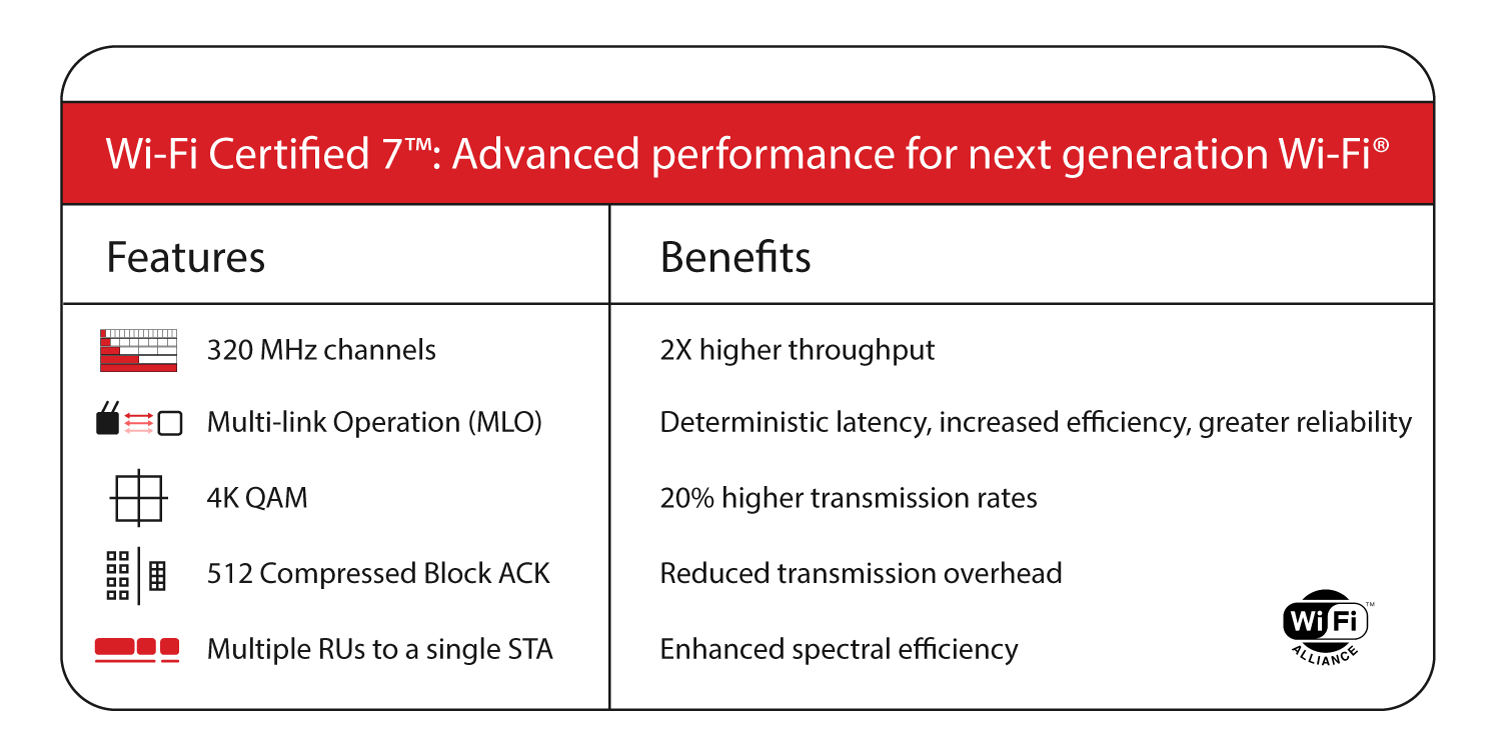
Wi-Fi 7 supports ultra-wide channels up to 320 MHz, but it also continues Wi-Fi’s path of backward compatibility and provides availability for even the narrowest 20MHz channels. It provides feature enhancements such as improved latency, scheduling efficiency, and future-proof certification without the overhead of wideband operation. The Wi-Fi Alliance offered this certification specifically for 20MHz channel device type certifications, an acknowledgement of the critical need for these types of devices.
Multi-Link Operation (MLO) is one of Wi-Fi 7’s most important architectural advancements, allowing multiple links across multiple frequency bands (2.4, 5, and 6 GHz) for higher speeds, load balancing, redundancy and reliability. Multiple variants of MLO are supported for varying applications, ranging from performance focused STR (Simultaneous Tx/Rx) and eMLSR (Enhanced Multi-Link Single Radio), to power saving and economical NSTR (non-Simultaneous Tx/Rx) an MLSR (Multi-Link Single Radio).
Wi-Fi 7 introduces 4096-QAM (4K QAM), increasing data density compared to 1024-QAM in Wi-Fi 6/6E. This enables up to 20% higher throughput within the same channel width, improving efficiency rather than simply increasing bandwidth.
Preamble puncturing allows Wi-Fi 7 devices to transmit over non-contiguous parts of a channel. This improves spectrum utilization in crowded RF environments and helps maintain performance even when interference is present. This is especially valuable for coexistence in industrial and dense IoT deployments.
Wi-Fi 7 expands multi-user MIMO and OFDMA capabilities, allowing more simultaneous users and devices with better scheduling and efficiency. This enables better performance in high-density environments while maintaining predictable latency and reliability.
| Feature | Wi-Fi 6 (802.11ax) | Wi-Fi 6E (802.11ax) | Wi-Fi 7 (802.11be) |
| Generation | 6th Gen | 6th Gen (Extended) | 7th Gen (Extremely High Throughput) |
| Max Theoretical Speed | Up to 9.6 Gbps | Up to 9.6 Gbps | Up to 46+ Gbps |
| Frequency Bands | 2.4, 5 GHz | 2.4, 5, 6 GHz | 2.4, 5, 6 GHz |
| Max Channel Width | 160 MHz | 160 MHz | 320 MHz |
| Modulation | 1024-QAM | 1024-QAM | 4096-QAM (4K-QAM) |
| OFDMA | YES | YES | YES |
| MU-MIMO | YES | YES | YES |
| 6GHz Spectrum | NO | YES | YES |
| MLO | NO | NO | YES |
| Multi-RU | NO | NO | YES |
| Preamble Puncture | NO | Optional | YES |
| Latency | Low | Lower | Extremely Low (Real-time) |
| Max Spatial Streams | 8x8 | 8x8 | 16x16 |
The wireless software layer that fits your environment — not the other way around. 75+ kernel versions supported (v2.6–v6.12+), bi-annual CVE releases, WPA3 Enterprise + EAP-FAST, and Adaptive Worldwide Mode. When an Ezurio Wi-Fi module is in your SOM, the full connectivity stack comes with it — one vendor for silicon and software.

Ezurio, as a Platinum Partner, is proud to collaborate with Infineon Technologies, a global leader in wireless silicon innovation. By integrating Infineon’s cutting-edge Wi-Fi 7 chipsets into our embedded module platforms, we’re able to bring best-in-class wireless performance to your applications—with full regulatory support, security, and long-term product availability.
Our engineering teams work closely with Infineon on:
This partnership ensures that Ezurio Wi-Fi 7 products deliver the stability, performance, and scalability required for industrial, medical, and enterprise applications.

At Ezurio, we are engineering Wi-Fi 7 solutions optimized for embedded, IoT, medical, and industrial applications. Working closely with silicon leader Infineon Technologies, we are focused on bringing Wi-Fi 7 to market with the performance, reliability, and long-term support our customers expect from our wireless modules and embedded systems.
Our new Sona™ IF7x3 answers the call for next-gen wireless
IoT. It is purpose-built for industrial IoT connectivity with access to a SDIO
Wi-Fi and UART Bluetooth host interfaces, industrial operating temp range,
latest generation Wi-Fi and BT, with an option for 802.15.4, combined with both
pluggable card and SMT M.2 packaging.
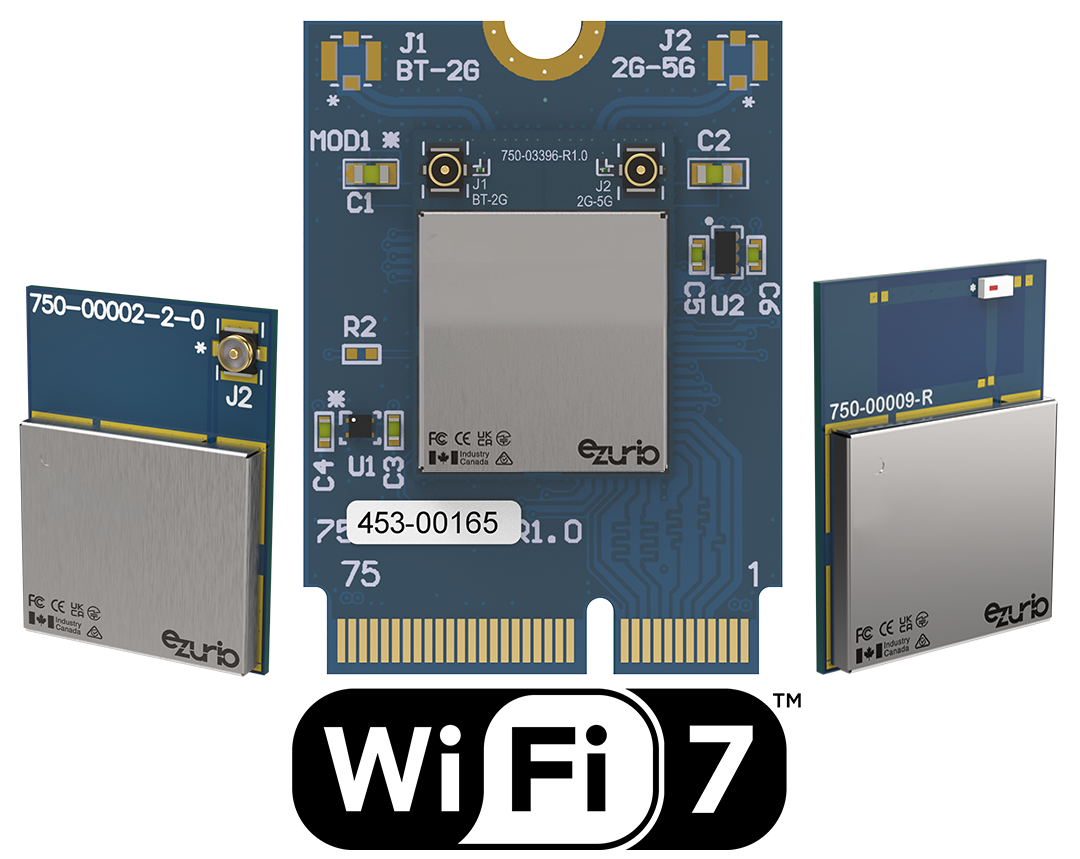
Tri-band Wi-Fi 7 + Bluetooth support in M.2 1216, 1218, and 2230 form factors. Choose from 1x1 shared antenna, antenna diversity with MHF4 or trace pin, or chip antenna.
Tri-band Wi-Fi 7 + Bluetooth + 802.15.4 (Thread/Matter) support in M.2 1216, 1218, and 2230 form factors. Choose from 1x1 shared antenna, antenna diversity with MHF4 or trace pin, or chip antenna.
Designed to meet growing demands for bandwidth-intensive and real-time applications, Wi-Fi 7 brings a host of benefits that make it a truly next-gen Wi-Fi experience.
/filters:background_color(white)/2025-02/wifi7_a.png)
Wi-Fi networks have become the backbone of connectivity in modern medical, industrial, commercial, and automation systems. Right now, the majority of Wi-Fi devices coming to market are based on...