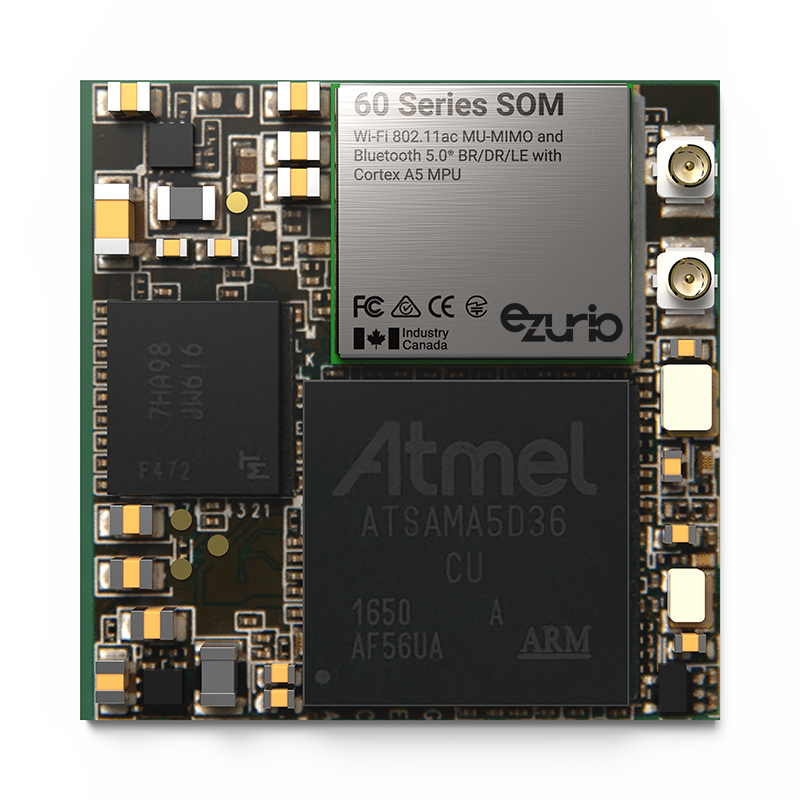
One key point is that a System-on-Module is not the same as a System-on-Chip (SoC). An SoC is a single silicon chip that integrates a CPU core (or multiple cores) along with built-in peripherals on one die. ARM SoCs (such as those from NXP i.MX or Qualcomm Snapdragon families) provide the processing and maybe some hardware accelerators on one integrated chip. An ARM SoM, by contrast, includes that SoC plus all the supporting components (high-speed memory, flash storage, oscillators, etc.) assembled on a main board. This gives the SoM a physical form factor (often credit-card sized or smaller) that can be handled like a small board rather than a delicate BGA chip, making it a plug-and-play module for embedded design. It also means the module can incorporate features that wouldn’t fit on a single chip – for example, high-density RAM, power regulation circuitry, and even wireless radios or sensors. In summary, the ARM SoC is the integrated processor chip, while the ARM SoM is a module containing that chip and everything needed to make it a working computer.
Another distinction is between a System-on-Module and a Single-Board Computer (SBC). A single-board computer (like a Raspberry Pi or BeagleBone) is a complete standalone board with processor, memory and all necessary connectors on one board. A SoM, on the other hand, usually lacks the physical ports/connectors for peripherals – those are provided by the carrier board. The SoM often uses board-to-board connectors or an edge connector to interface with the carrier. This modular approach yields a smaller core module and allows the carrier board to be customized or simplified, since the complexity is largely confined to the SoM itself. In practice, an ARM SoM is sometimes called a Computer-on-Module (CoM) – the terms are often used interchangeably – and it represents a middle ground between building a device entirely from scratch (chip-down design) and using an off-the-shelf SBC.
Architecture and Key Components of an ARM SoM
At the heart of an ARM SoM is, of course, an ARM-based processor or SoC. ARM processors (based on the RISC architecture originally from Advanced RISC Machines) are widely used in SoMs due to their excellent balance of performance and energy efficiency. Around this processor, the module integrates a number of essential components that together form a complete embedded computing system. Typical components found on an ARM System-on-Module include:
- ARM CPU / SoC: The central processor, often a multi-core ARM Cortex-A series or similar, which executes the operating system and application code. This could be, for example, an NXP i.MX, TI Sitara, or another ARM SoC, providing processing, graphics, and maybe on-chip peripherals. The ARM SoC is the primary computing engine and defines the performance and capabilities of the module.
- Memory (RAM & Flash): SoMs include volatile memory (DDR RAM) for program execution and data, as well as non-volatile storage (e.g. NAND flash or eMMC) to hold the bootloader, OS, and persistent data. High-speed memory like DDR3/DDR4 is soldered close to the CPU on the module to ensure fast data access, and flash provides storage without needing an external drive.
- Power Management: Integrated power management ICs (PMICs) on the module handle voltage regulation and power sequencing for the SoC and other components. This ensures that the various parts of the SoM receive stable power (often converting from a single supply on the carrier board) and that startup/shutdown sequences are properly managed – a critical aspect for reliability in embedded systems.
- Clock & Reset circuitry: The module will typically have clock oscillators or crystals for timing (e.g. a clock source for the CPU) and reset generation circuits. These ensure the SoC and peripherals operate with the correct timing and can be reset reliably.
- I/O Interfaces: A variety of interface controllers are part of the SoM design. Common high-speed interfaces exposed include USB ports, Ethernet MAC (often two for industrial use), display interfaces (LCD/MIPI DSI or HDMI), camera inputs, and PCIe or SDIO. Additionally, low-speed interfaces like UART, I²C, SPI, CAN bus, and GPIO are provided via the module’s connectors, allowing connection to sensors, actuators, and other peripherals on the carrier board. Essentially, the SoM brings out all the I/O signals of the SoC to defined pins/pads so the carrier can use them as needed.
- Wireless connectivity (optional): Many modern ARM SoMs integrate wireless modules or chipsets, such as Wi-Fi and Bluetooth radios, and sometimes cellular (LTE/NB-IoT) or GNSS receivers. These pre-integrated wireless features are especially common for IoT-focused SoMs, giving the module built-in connectivity. Some modules even come with pre-certified radio chips and antennas, which simplifies adding wireless connectivity to your product (no need to design RF circuits or go through separate FCC certification in many cases).
- Other peripherals: Depending on the target application, a SoM might also include additional elements like security chips (TPM/security IC) for encryption, FPGA or microcontroller co-processors (in hybrid SoM designs), or analog components. For example, there are SoMs that combine an ARM processor with an FPGA on the same module for high-performance industrial tasks. These additional components extend the capabilities of the module beyond what the main SoC alone provides.