/filters:background_color(white)/2024-09/Tungsten%20510%20-%20MT320%20M2.2-1420%20-%20Front.png)
Choosing the Right SOM: Why MediaTek Genio Stands Out
Find out where the MediaTek's Genio-based SOMs, Tungsten 510 and Tungsten700, differentiate.
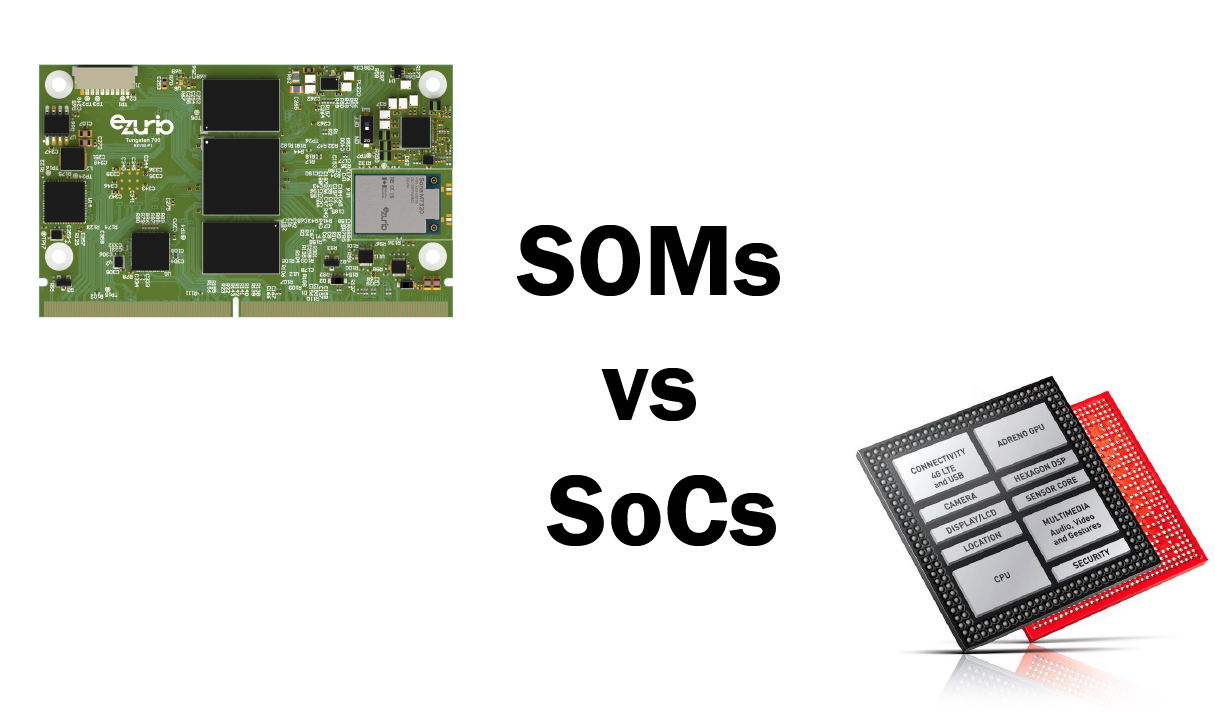
Choosing between SOMs or SoCs is an important choice for your project. Explore the benefits of each and how they can be leveraged to meet your specific design requirements.
By Mike Ulanski
Published on April 25, 2024
In embedded systems design, the choice between a System-on-Module (SOM) and a System-on-Chip (SoC) can significantly influence the efficiency, cost, and scalability of engineering projects. This blog post dives into the distinctions between SOMs and SoCs, helping electrical engineers, embedded system designers, and technical product managers to determine which solution best fits their specific hardware project needs, particularly in sectors like IoT and AI.
Embedded systems rely heavily on integrated circuits (ICs) to perform their functions. These systems are at the heart of many modern electronic applications, from simple household appliances to complex industrial machinery. Two common forms of ICs in these applications are System-on-Module (SOM) and System-on-Chip (SoC). Each offers unique benefits and limitations depending on the application's requirements. Choosing the right type can significantly affect project outcomes, impacting everything from production cost to final product functionality.
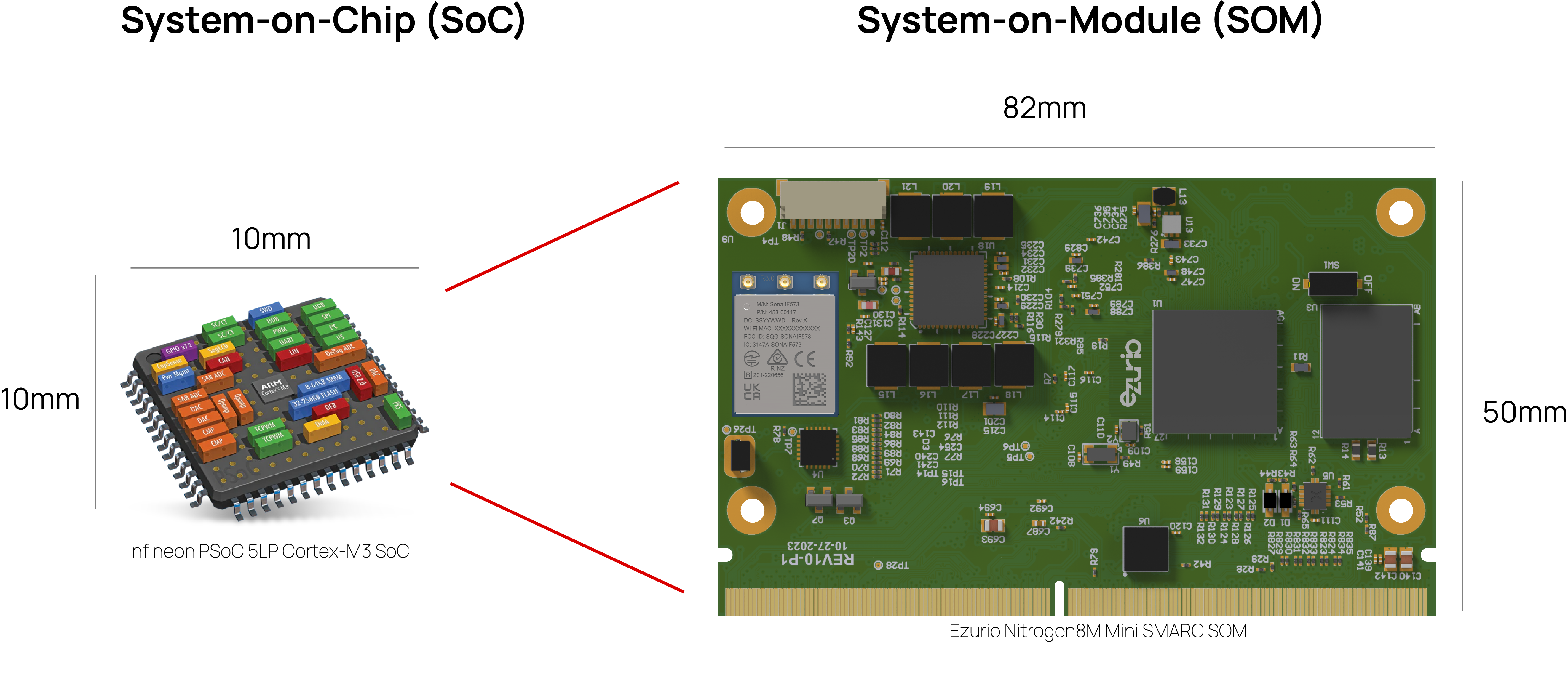
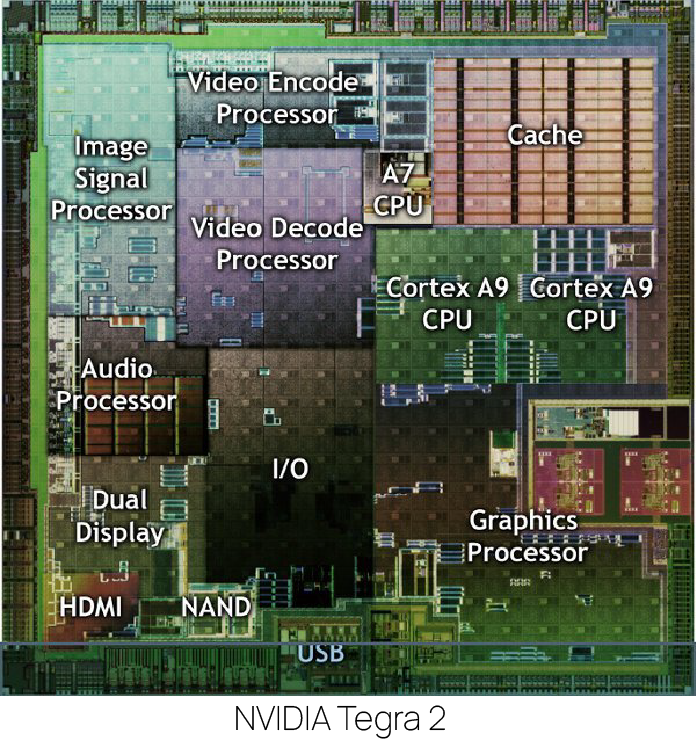
A System-on-Chip (SoC) is essentially an entire computer squeezed into one integrated circuit. All the essential components – CPU, memory, input/output interfaces, sometimes even wireless radios – reside on a single piece of silicon. In other words, an SoC integrates everything needed for computation onto one chip, except perhaps a power source. This high level of integration means an SoC can function as the brain of a device with minimal external components.
Common components of SoCs:
System-on-chips usage is dominant in:
The primary advantages of using SoCs include:
A few examples of SoCs are Qualcomm’s Snapdragon series, Apple’s A-series, and Samsung’s Ezynos.
These benefits come with trade-offs. Developing or customizing an SoC (for those few companies that create their own chips) involves very high upfront design costs and complexity. Even using an off-the-shelf SoC in a custom board requires careful hardware engineering – the designer must manage high-speed signals, power, and thermal design for that chip. Any major change (say you need a more powerful processor) could force a complete board redesign, since the SoC is fixed in place and not modular. This is where the alternative, the System-on-Module, enters the picture.
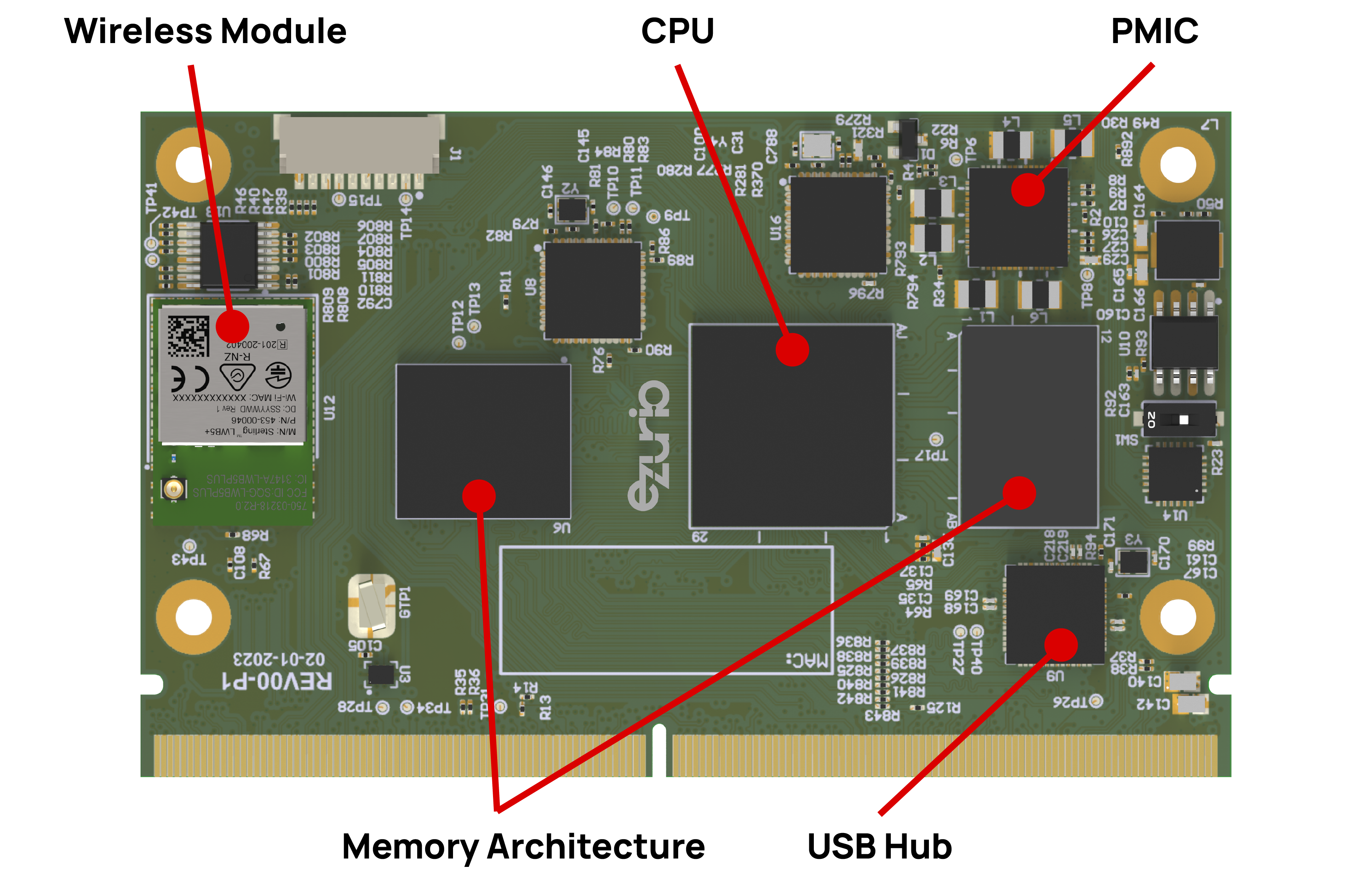
A System-on-Module (SoM) takes the concept of integration one step up – it is a compact board-level module that contains a complete computing system. In practice, a SoM is a small circuit board that hosts an SoC plus additional supporting components like memory, power management, wireless radios, and other interfaces. You can think of it as a little “computer core” that you plug into or solder onto a larger board (often called a carrier board) which provides application-specific connectors and peripherals. Importantly, an SoM is not a finished product by itself; it requires a carrier board or baseboard to connect to the outside world.
The SoM typically exposes connectors or pins for interfacing with the carrier board, carrying signals for I/O, power, etc. Once mated with a carrier board, the combination behaves like a single integrated system. In essence, the SoM serves as the processing heart (CPU, memory, etc.), while the carrier board is the skeleton that adds form factor, IO connectors, sensors, and power supply to complete the product.
Common components of SOMs include:
SOMs are typically used in:
Benefits of SOMs include:
A few examples from Ezurio are our Open Standard Modules (OSM), MediaTek Genio powered SMARC SOMs, and NXP’s i.MX powered SMARC SOMs.
Now that we’ve defined each, let’s compare SoC and SoM differences in the context of embedded system design. Both SoCs and SoMs (like our IMX95 SoM)integrate a computing system, but they do so at different levels (chip-level vs board-level integration). This leads to distinct advantages and disadvantages in various aspects of design. Below, we break down the key factors:
SoC: Highest level of integration at the silicon level – everything is on one chip. This is excellent for minimizing size and maximizing efficiency in a fixed design. However, it’s inherently inflexible: once you’ve chosen or designed an SoC, any significant change (like adding a new interface or a more powerful processor) would likely require a new SoC design or a different chip altogether, which means a major redesign of your hardware. An SoC-based design is tightly coupled to the specific chip’s capabilities, with little room for post-deployment modifications.
SoM: High integration at the module/board level, but with modularity built in. The SoM encapsulates a lot of complexity but still plugs into a socket or footprint on your carrier board. This means you can achieve flexibility that SoCs alone can’t. For example, if you want to upgrade your device’s processor or add more RAM, you might simply swap out to a newer SoM that is pin-compatible, rather than redesign everything. Users can even evaluate different processors by trying different SoMs on the same carrier board footprint. This flexibility accelerates development and future-proofs designs, especially useful in fast-evolving markets like IoT where you may need to update hardware capabilities every couple of years. In short: SoCs offer integration, while SoMs offer integration plus modularity. The modular approach increases flexibility without compromising the benefits of integration which is a big reason why SoMs are popular in industrial settings where long-term adaptability is needed.
SoC (Custom Board): Designing a product around a raw SoC means you are responsible for all the hardware integration. High-speed memory routing, RF design, power circuits, clock crystals, numerous peripherals – your engineering team must handle it all and ensure it works reliably. This requires specialized expertise in hardware design, signal integrity, PCB layout, and so on. It also means longer development cycles: each prototype iteration might reveal hardware bugs that need fixing, and the bring-up time (getting your OS and software running on the new custom hardware) can be significant. For complex SoC-based designs, it’s not uncommon to spend many months (or more) in hardware development and testing before the product is market-ready. In summary, SoC-based development tends to be slower and riskier upfront, but may pay off for very high-volume products later.
SoM: Incorporating a System-on-Module can dramatically shorten development time. Much of the difficult hardware design is already done and tested on the module. As one source puts it, all the complexity is encapsulated in the SoM, so the carrier board can be easily developed. Engineers don’t need as deep hardware expertise to get started – they can leverage the module vendor’s design. This means faster prototyping; teams can often get a system running on an eval carrier board and then just design a simple carrier for their specific needs. Time-to-market is reduced because you’re essentially integrating a pre-made subsystem. One vendor notes that using SoMs “significantly reduce[s] development complexity and cost”, making them ideal even for low-to-mid production volumes. Moreover, since many SoMs come with ready OS images and driver support, software development can proceed in parallel with hardware, further accelerating the schedule.
The trade-off in using a SoM is that you might not achieve the absolute lowest unit cost or the tightest integration possible, but you gain speed and reduce risk. Especially for startups or teams aiming to demonstrate a product quickly, getting to market faster with a module can outweigh the optimizations that a ground-up SoC design might allow.
When comparing SoC vs SoM, cost needs to be looked at from two angles: the engineering/development cost and the per-unit production cost.
Development Cost: SoC-based projects usually entail high initial costs. Custom board design and debugging require expensive expertise, possibly specialized EDA tools, multiple PCB spins, and certification processes. This upfront investment is only justified if you plan to ship large volumes (to amortize the NRE – non-recurring engineering costs). In contrast, starting with a SoM has lower initial investment. The module may be pricey per unit, but you save on development of complex aspects like memory interfacing and RF tuning. There’s no need for costly one-off chip integration efforts when the SoM is already proven. One source summarizes that SoMs can be more cost-effective especially where production volumes do not justify the high setup costs of SoC development.
Production Cost: Here, the equation can flip depending on scale. SoCs excel in high-volume, cost-sensitive products – if you’re making millions of identical devices (think of a mainstream consumer gadget), even a few dollars saved per unit by using a bare SoC instead of a more expensive module adds up. So for mass-produced, standard products, an SoC approach often yields the lowest unit cost. In contrast, SoMs add cost per unit because you’re essentially purchasing an assembled sub-board with markup. For low to moderate volumes, this added cost might be acceptable or even cheaper when you factor in saved engineering effort. But for very large volumes, many companies will bite the bullet and do a custom SoC-based board to minimize recurring costs.
Another cost-related factor is certification and compliance. A SoM that is pre-certified can save a lot of money (and time) that you would otherwise spend on FCC/CE testing, PTCRB (for cellular), or other regulatory compliance for each new board design. This effectively reduces the hidden costs in development. Additionally, SoM vendors often handle supply chain and component sourcing for the module, which can reduce cost volatility for you – whereas if you design around an SoC, you must source all components (PMICs, RAM, etc.) yourself in production, and any supply issue can increase costs unexpectedly.
Because an SoC is one integrated chip, it is typically optimized for performance and power efficiency in ways a more general module might not be. For battery-powered or ultra-compact devices, using the SoC directly on a custom board might achieve slightly better power usage and a smaller footprint than plugging in a module. SoCs are beneficial for applications where size and power are absolutely critical, such as wearables or tiny IoT sensors. In those scenarios, the added PCB and connectors of a SoM could be a limitation.
That said, many System-on-Modules are quite small (some stamp-sized or smaller) and use the same low-power SoCs internally, so the difference can be minor. It’s often possible to find a SoM that meets stringent size and power requirements if one looks carefully. Still, if you’re pushing the limits of miniaturization, a custom SoC design might be the only way to get exactly what you need.
In terms of performance, there is usually no inherent difference between an SoC and a SoM using that same SoC. A SoM won’t magically be slower; it contains the same processor, so performance depends on the chip inside. One nuance: SoMs sometimes use slightly less powerful SoCs that are designed for embedded modules, as opposed to the bleeding-edge chips found in flagship smartphones (which often are only available as standalone SoCs). But increasingly, SoMs are available for high-performance processors too. For example, there are modules with high-end application processors and even FPGAs, aimed at AI and vision processing. Thus, both approaches can satisfy performance needs, but SoCs might lead in ultra-optimized power-performance scenarios, whereas SoMs lead in convenience at a slight cost of overhead.
Reliability has a couple of meanings here: hardware reliability in the field, and consistency/maintenance over the product’s lifecycle.
Hardware Reliability: An SoC, being highly integrated, reduces the number of external solder joints and components, which can improve physical reliability (fewer things to break or connectors to fail). However, a System-on-Module is typically a professionally designed and tested unit, often built to meet industry standards for shock, vibration, and temperature. In fact, SoMs are usually designed, manufactured, and tested to meet stringent industry reliability standards from the get-go. This means that if you use a reputable SoM, you inherit a level of robustness and validation that might be hard to achieve on the first revision of a custom design. The module likely has already gone through temperature cycling, EMC testing, etc., so you start from a known good baseline. This can reduce the risk of hardware failures in the field for your product. In industrial and medical contexts, where failure is not an option, that proven reliability is a big plus for SoMs.
Lifecycle and Longevity: Industrial and medical devices often need to be supported for many years, sometimes a decade or more. Here, SoM vendors often shine: they tend to provide long-term support for their modules, including documentation, software updates, and a commitment to supply modules or equivalent replacements for a long time. Many SoM families are advertised with 7, 10, or even 15+ year availability. For example, a module based on an NXP industrial processor might be guaranteed for 10-15 years of supply. This long lifecycle support means you can design it into a medical device and not worry about redesign for obsolescence for a while. Additionally, because of the modular swap-out ability, if a component on the SoM does become obsolete, the vendor might offer an updated module as a drop-in replacement. On the flip side, if you roll your own SoC-based board, managing component obsolescence is on you – if the SoC or a key component is discontinued, you may face a redesign.
Upgradability: in industrial settings, technology evolves, but machines might be deployed for 20 years. SoMs allow incremental upgrades to keep systems up-to-date. One real-world example is using an upgraded SoM in older industrial equipment to add new features like better connectivity or AI processing, thereby extending the life of the equipment without a full overhaul. This kind of upgrade path is far easier with modules than with fixed SoCs.
Vendor Lock-in Risk: A note on reliability of supply: choosing a SoM does mean you rely on that vendor. If the vendor goes out of business or discontinues the module, you could be in a tough spot (needing to find a pin-compatible replacement or redesign). Mitigating this means choosing SoM vendors with a good track record and industry standard form factors (like SMARC, COM Express, OSM, etc., which at least gives some cross-vendor compatibility). With an SoC and custom design, you are dependent on the chip manufacturer to keep making that SoC (and they eventually will EOL it too). So either way, long-term availability is a concern – just be sure to plan for it.
The following table outlines the advantages and disadvantages of SOM and SoC, providing insights on development time, risk, initial cost, and suitability for different types of applications:

| Feature | System-on-Module (SOM) | System-on-Chip (SoC) |
|---|---|---|
| Flexibility | High (modular components) | Low (integrated design) |
| Cost in Design Phase | Lower initial investment; Lower with design changes |
Higher initial cost; Higher with design changes |
| Development Time | Shorter due to modularity | Longer due to integration |
| Risk | Lower (easy to modify or replace parts) | Higher (costly redesigns) |
| Application Suitability | Custom, variable projects | Mass-produced, standard products |
In real-world applications, SoCs and SOMs have distinct roles. Let’s look at some examples.
Industrial IoT systems (such as factory automation controllers, robotics, smart sensors for utilities, etc.) often have rugged requirements and long service life. The environment is harsh, and the technology needs might change over decades. Here’s how SoC vs SoM plays out in this domain:
Rapid Development vs. Custom Optimization: Industrial companies often want to prototype and deploy solutions quickly to stay competitive. A System-on-Module can be a game-changer for rapid development – it provides a stable core so that engineers can integrate it into, say, a new machine vision system or a predictive maintenance sensor, with minimal hardware fuss. Instead of spending a year designing a complex board, they can use that year refining their control algorithms or software features. This speed is crucial because industrial IoT is evolving fast, and being late to market could mean losing out on efficiency gains or business opportunities.
Ruggedness and Reliability: Factories and field environments demand reliable hardware. As discussed, SoMs come pre-tested for reliability and often offer industrial temperature ranges (e.g. -40°C to +85°C) as standard. Many industrial SoMs are built for robustness., with features like error-correcting code (ECC) memory to handle radiation or interference, and high-quality connectors. So while a custom SoC-based board can be made rugged, using a proven module de-risks the reliability aspect – you know the core of your system has been validated under stress. This is one reason SOMs are highly valued in industrial automation for their robustness.
Longevity and Upgrade Path: Industrial equipment might be deployed for 10-20 years. It’s not feasible to redesign electronics every couple of years in that context. SoMs offer a nice solution: you can design your carrier board and standardized module slot once, and stick with that platform for a long time. If a new performance requirement or interface comes along (for example, suddenly machines need a new AI accelerator or a new wireless standard), you can upgrade the module without redesigning the whole system. One example cited in industry is using a new SOM to retrofit older machinery – e.g., replacing the module with one that has a more powerful processor or updated wireless connectivity (Wi-Fi 6, Bluetooth 5.x, etc.) to give old equipment new capabilities with minimal downtime. This extends the life of industrial assets and avoids costly complete overhauls.
Volume and Cost Trade-off: Some industrial IoT applications are produced in moderate volumes (hundreds or thousands of units, not millions). In these cases, the cost penalty of a module is usually acceptable given the development savings. However, if you’re an industrial sensor manufacturer shipping tens of thousands of simple sensors per year, you might consider a custom SoC-based design to shave unit costs. We see both models: for example, a giant company making simple IoT sensors (like temperature/humidity nodes) in bulk might use a system-on-chip (or even just a microcontroller SoC) on a custom board to minimize BOM cost. On the other hand, a smaller company making high-value, low-volume equipment (e.g., a specialized robotic controller) will almost certainly opt for an SoM to avoid reinventing the wheel.
Examples: To avoid specific brand comparisons, consider a generic scenario: An industrial gateway device that collects data from various sensors on a factory floor and sends it to the cloud. Using an SoM, the developers can get a Linux computer up and running quickly on the gateway, complete with Ethernet, Wi-Fi, and fieldbus interfaces (many SOMs include these). They can focus on writing the firmware that translates sensor protocols (MODBUS, CAN, etc.) and leave the low-level Linux porting to the module provider. The result is a faster deployment of a reliable gateway. If in a few years a new AI algorithm requires more processing power, they can upgrade to a pin-compatible SoM with a faster processor and perhaps added AI acceleration, without changing the gateway’s overall design. This is a common pattern in industrial IoT development – design for today, but keep a path to upgrade for tomorrow, which SoMs support beautifully.
Industrial Standards: It’s worth noting that industrial and embedded computing have standardized form factors for modules, such as SMARC, Qseven, COM Express, OSM (Open Standard Module), etc. Choosing a SoM that adheres to one of these standards can further ensure long-term availability and multi-sourcing. Your carrier board could potentially accept a similar module from another vendor if needed. SoCs, in contrast, don’t have that kind of cross-compatibility – each board is unique to the chip and design.
In summary, for industrial IoT applications, SoMs often provide an optimal balance of reliability, longevity, and flexibility, albeit at a higher unit cost. SoCs might be used when unit cost and size trump all other considerations, or when a company has the resources to design a custom solution from scratch for a very specific high-volume need.
Medical and healthcare IoT devices range from wearable health trackers to sophisticated diagnostic machines. Two critical concerns in this field are safety/reliability and regulatory compliance, both of which influence the SoC vs SoM decision.
Regulatory Compliance & Certification: Medical devices that incorporate wireless connectivity (which many modern IoT-enabled ones do) must comply with regulations (FCC, CE for radio, and FDA requirements for medical). Using a communication module or SoM that is pre-certified can streamline the regulatory approval process. For example, if you’re building a connected patient monitor that uses Wi-Fi/Bluetooth to transmit data, a SoM that includes a pre-approved wireless module means you don’t have to separately certify the radio as a new design. This can save months in testing and paperwork. In some cases, it can also help with medical standards compliance, since the module’s design history might be documented (useful for ISO 13485 processes, etc.). Thus, medical IoT developers often lean towards modules to “provide pre-certified, tested modules” for connectivity and processing, reducing the burden of proving out the hardware’s safety and compliance.
Focus on Core Expertise: Many medical device firms have more expertise in clinical or biomedical engineering than in complex electronics design. If you’re designing, say, a new portable ultrasound or a smart insulin pump, your competitive edge might lie in your sensing technology or your analytics software, not in designing yet another compute board. A SoM allows the team to focus on their core competency (application software and biomedical features) while the hardware platform is largely solved. As noted earlier, with hardware complexity managed by the SOM, development teams can channel their efforts into software and functionality – a crucial benefit when trying to innovate in healthcare.
Reliability and Quality Assurance: Medical devices must work consistently and safely – lives can quite literally be on the line. So, starting from a high-quality, tested module can instill confidence in the design’s reliability. SoM manufacturers often perform extensive testing and quality assurance, and they may comply with medical-grade quality standards themselves. By using those modules, a medical device developer inherits that quality. Additionally, if any hardware issues are found (say a certain component has an errata), the SoM vendor’s support can be leveraged to resolve it. This is one reason SOMs are used in devices like patient monitors; manufacturers can trust the module to handle the computing reliably while they ensure the overall device meets medical regulatory requirements.
Size and Power Concerns: In some cutting-edge medical IoT gadgets, like wearable health monitors or implanted sensors, size and power are at a premium. These might use highly integrated SoCs (or even custom ASICs) because a module would be too big or power-hungry. For instance, a fitness tracker or a cardiac monitor patch might be built around a System-on-Chip since it needs to be very small and runs on a tiny battery. SoCs are common in consumer-grade health wearables for this reason (they’re essentially like any other wearable device). But for slightly larger portable devices, e.g. a point-of-care diagnostic tablet or a medical imaging handheld, a SoM can often fit while providing much greater functionality. In hospital equipment (which is less constrained by size), SoMs are even more viable.
Long-Term Support: Medical devices often have a long development and approval cycle, and once approved, they might remain in service with minimal changes for years. Thus, designers are cautious about component longevity. Here SoM vendors’ long-term support is very attractive. If you design in a SoM that the vendor commits to produce for 10+ years, that means your device’s main computing part is secured. You won’t need to go through re-certification due to an unplanned hardware change for a good part of a decade. If a change is needed, ideally the vendor provides a form-fit-function compatible successor. This kind of stability aligns well with medical device lifecycles.
Example Scenario: Imagine a portable cardiac ultrasound unit used by emergency responders. It needs to process ultrasound signals (which is compute-intensive), display images, and perhaps wirelessly transmit data to a hospital. The development team could choose an SoM that has a powerful SoC (for signal processing), on-board GPU (for image rendering), and Wi-Fi/BT. Using the SoM, they get a Linux environment up quickly to run their imaging software. The module’s GPU acceleration and drivers are already in place, so they don’t need to write low-level code for that. They integrate the SoM into a custom handheld enclosure with a battery and a display (via the carrier board). Because the SoM is pre-tested, they encounter fewer hardware issues during development, and they can focus on perfecting the imaging algorithms and user interface. The device gets to market faster, and because the SoM was from a vendor with a known track record in medical applications, they have support if something needs tweaking. Had they instead tried to design a custom board around the raw SoC, they might spend extra time debugging high-speed DDR memory issues or radio interference problems – time that’s precious in a competitive medtech market.
In summary, medical IoT projects often favor SoMs unless the device is so constrained or so high-volume that a custom SoC design is warranted. The ability to cut down on certification effort, ensure reliability, and leverage vendor expertise is extremely valuable in the medical field. SOMs help streamline the development of compact, reliable medical devices – as one source notes, they are instrumental in devices like portable diagnostics and patient monitors by providing pre-certified building blocks
Choosing between a System-on-Module and a System-on-Chip is a critical decision that depends on specific project requirements and constraints. Engineers must consider factors such as flexibility, cost, and intended application to determine which solution best fits their needs.
If you're planning your next embedded project, carefully assess your requirements and consult with experienced hardware engineers to choose between SOM and SoC effectively. The right choice can lead to better performance, cost savings, and product success. Considering the complexities and rapid development in the fields of IoT and AI, adopting a strategic approach when selecting between SOM and SoC is more crucial than ever. Be sure to stay informed and choose wisely!
Ezurio turns design possibility into reality with a comprehensive range of RF modules, system-on-modules, single board computers, internal antennas, IoT devices, and custom solutions. With decades of engineering expertise, Ezurio provides solutions that reduce development costs and time to market. Our global reach and unmatched support are backed by a resilient global supply chain that gives our customers the stability to overcome every design challenge with confidence. Turn design possibility into reality with Ezurio, your connectivity expert.
Find out where the MediaTek's Genio-based SOMs, Tungsten 510 and Tungsten700, differentiate.
/filters:background_color(white)/2026-01/cover%20image%20edge%20ai%20blog.png)
Reliable edge AI depends on system-level integration across processing, wireless, and lifecycle support.
/filters:background_color(white)/2026-05/Thumbnail.png)
In this video ipXchange's Adam Yap met with Ezurio's Florian Baumgartl and Jonathan Kaye to talk about our Carbon AM62 SOM. The Carbon AM62 OSM-MF series is built around Texas Instruments’ AM625...
/filters:background_color(white)/2026-02/From%20Edge%20AI%20Demo%20to%20System%20image.png)
Most Edge AI demos succeed. Most Edge AI product struggle to reach production. The difference isn’t the model, but if the entire system was designed, validated, and supported for real-world deployment.
/filters:background_color(white)/2026-05/93-vs-95-tn3.png)
Selecting a System on Module platform early in a design cycle is one of the highest-leverage decisions an embedded engineer makes — and one of the hardest to reverse. Both the NXP i.MX 93 and i.MX...
/filters:background_color(white)/2025-10/Nitrogen95-EVK-Camera-Large.png)
Learn how Ezurio can help integrate external cameras easily to your design
/filters:background_color(white)/2026-09/15%20-%20CarbonAM62.png)
Introducing the Carbon AM62 OSM SOM - A system-on-module that has an industry-leading compact size in a reliable solder down form factor.
/filters:background_color(white)/2024-07/sget-osm-modules-sizes-contacts-web.png)
Embedded engineers today face a dilemma: how to add more computing and connectivity into ever-smaller devices without reinventing the wheel each time. Open Standard Modules (OSM) have emerged as a...
/filters:background_color(white)/2026-02/Product-Portfolio-Cover.jpg)
A collection of our product offerings in modules, SOMs, and antennas. Updated Q3 of 2026.
/filters:background_color(white)/2025-09/Raising%20the%20bar%20for%20HMIs%20in%20food%20and%20beverage%20systems.png)
Learn how to avoid the common failures of multi-vendor HMIs with a platform that combines compute, wireless, and enclosure design from one supplier.
/filters:background_color(white)/2025-11/EZSMI-959-0816-00158-2-KC-nobg.png)
Evaluating the i.MX 95 for vision should not start with broken drivers and bad images. Here is the first EVK that gives engineers a real, working camera pipeline out of the box.
/filters:background_color(white)/2024-04/What%20Is%20a%20System-on-Module%20Cover%20Image.png)
Ezurio's system-on-module solutions are built on the latest processors and wireless, and utilizing our long-term software support to give developers a secure, smart, connected IoT platform.
/filters:background_color(white)/2024-10/60%20Som%20Render%20333.png)
An ARM System-on-Module (SoM) is a compact , ready-to-use computing module built around an ARM-based processor. In essence, it’s a small circuit board that contains the “brains” of an embedded...