Choosing the Right SOM: Why MediaTek Genio Stands Out

Find out where the MediaTek's Genio-based SOMs, Tungsten 510 and Tungsten700, differentiate.

Published on April 29, 2026

Choosing the Right SOM: Why MediaTek Genio Stands Out

At Ezurio, we don’t believe in a “one processor fits all” strategy. We support multiple silicon platforms because embedded systems have different constraints: power, graphics requirements, camera counts, AI workloads, cost targets, lifecycle expectations. Most design challenges are not about raw CPU speed. They’re about system balance. 

  • Can it render a fluid UI at 60 fps? 
  • Can it handle Chromium without lag? 
  • Can it decode 4K video without cooking the enclosure? 
  • Can it run AI? 
  • Can it do all of that inside a sealed chassis? 
That’s where the MediaTek Genio-based SOMs, Tungsten510 and Tungsten700, differentiate. Let’s break it down.

Where Genio Processors Actually Make a Difference


High-Performance Application Cores

A lot of modern embedded systems are no longer simple control interfaces. They’re running full Android or Linux-based graphical stacks that behave much closer to consumer devices than traditional HMIs. These workloads are latency-sensitive. App launches, browser rendering, touch interactions, and background services all compete for CPU time. 

This is where the Cortex-A78 cores in Genio 700 matter. On paper, it’s just a core upgrade. In practice, it changes how the system responds. You see it in faster app launches. You feel it in smoother scrolling and fewer dropped frames. Chromium doesn’t stall when JavaScript loads spike. The UI remains responsive even when background tasks are active. This isn’t about benchmarks. It’s about whether the system feels finished or frustrating. In customer-facing products like kiosks, fitness equipment, or smart displays, that difference is obvious immediately.
GPU Performance That Matches Display Expectations

Driving a display isn’t the challenge anymore. Driving it well is. 

Most systems today are expected to handle 4K, maintain 60 fps, support layered UI elements, and handle video overlays without stuttering. That combination puts real pressure on the GPU and memory subsystem. 

Genio 510 and 700 use Mali GPUs that are well-balanced for this kind of workload. The pixel fill rate and compute capability are there to support 4K rendering without starving the rest of the system. 

In real designs, that shows up as stable video playback, responsive UI even at higher resolutions, and enough GPU headroom to handle animations or WebGL without impacting performance elsewhere. A lot of platforms can claim 4K output. Fewer can sustain it alongside a responsive UI in a fanless design. 

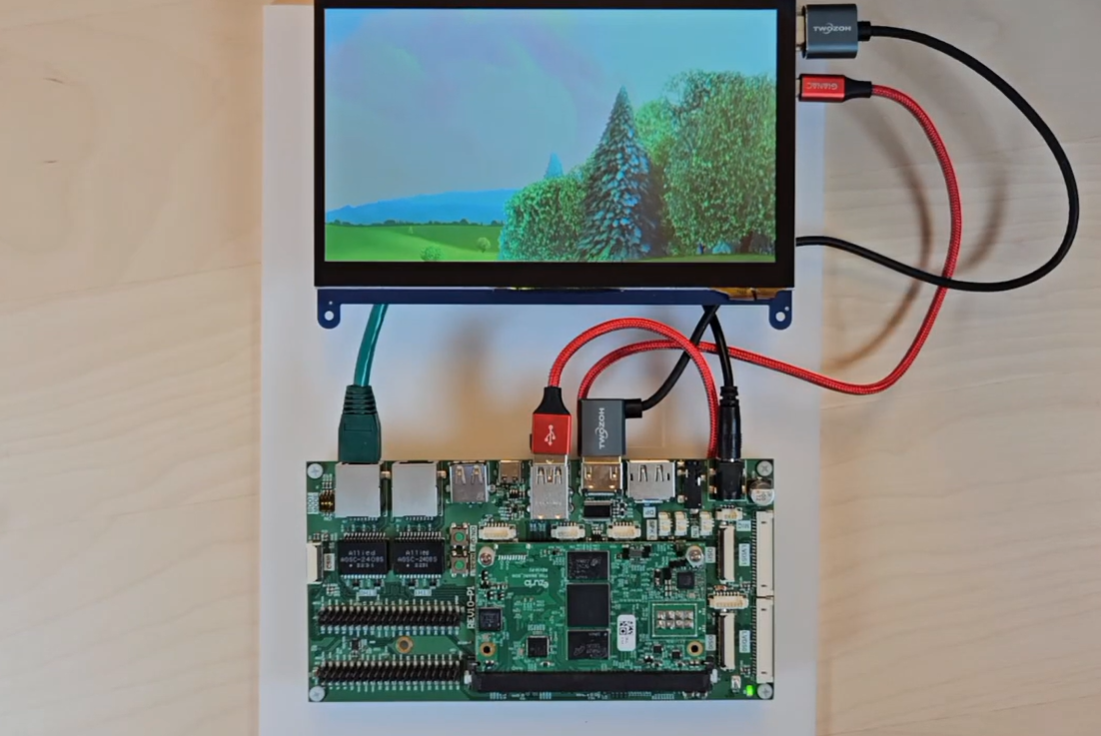
Check out the GPU Performance of the Tungsten700 SMARC SOM 

This video evaluates the graphical performance of the Ezurio Tungsten 700, powered by the MediaTek Genio 700 processor. 

Using the Kynetics Embedded Android Developer Toolkit, we tested:

  • 1080p video playback at 60 FPS
  • OpenGL and Vulkan GPU performance
  • 2D and 3D graphics rendering

Learn more about Kynetics and their Embedded Android Developer Toolkit

Evaluating Tungsten700 GPU Performance.png

AI Acceleration That Doesn’t Break the System

AI at the edge is no longer a future feature, it’s a design requirement in many verticals: people detection, object classification, gesture interfaces, smart retail analytics, predictive maintenance. 

Genio 700 integrates a multi-TOPS NPU designed to accelerate support neural network layers in hardware. But the key advantage is not just peak TOPS. 

Real-world AI performance also depends on memory bandwidth and CPU preprocessing. Because the Genio processor pair a capable CPU with high-performance application cores and a strong GPU, it maintains system responsiveness even when AI workloads are active. 

In practical deployments, that means:

  • Running vision inference while maintaining 60 fps UI
  • Streaming video while executing AI models
  • Avoiding CPU saturation during preprocessing

Video Acceleration That Protects CPU

Video is still one of the fastest ways to break a design if it’s not handled correctly. 

Without a dedicated VPU, even 1080p decoding can eat up most of the CPU. Once that happens, UI performance drops, thermals increase, and the system becomes unstable under load. 

Genio platforms include hardware video encode and decode support for modern codecs, which keeps that workload off the CPU. The result is straightforward: the CPU stays available for application logic, AI workloads don’t compete with video processing, and 4K playback remains smooth without driving up power consumption.

Check out the video capabilities of the Tungsten700 using a 4K display

13.3 inch 4K OLED Display + our Tungsten700 SMARC - with Lincoln Technology Solutions Thumbnail.png

When Genio-Based SOMs Make Sense

From a design standpoint, Genio-based SOMs are a strong fit when the system isn’t just doing one thing. 

MediaTek Genio-based SOMs are particularly strong when your design includes:

  • Rich Android-based HMI
  • Chromium or web-heavy interfaces
  • 4K display requirements
  • AI inference at the edge
  • Concurrent video + UI + AI workloads
  • Fanless or thermally constrained enclosures
  • User experience as a product differentiator
If the end user interacts with the system directly, responsiveness becomes part of the product. That’s usually the tipping point where Genio starts to stand out

Final Thoughts

Choosing a SOM isn’t about picking the fastest processor on paper. It’s about understanding how CPU, GPU, NPU, memory bandwidth, and video acceleration work together under real workloads. 

Genio 510 and 700 are strong because they’re balanced. You get high-performance application cores where they matter, GPU capability that supports modern displays, dedicated AI acceleration, and hardware video processing, all within a power envelope that works for embedded designs. 

From an engineering standpoint, that balance reduces risk. It gives you margin in performance, thermals, and future feature expansion. And in most projects, that margin is what keeps you from having to redesign the system six months later.


Tungsten700 SMARC

  • MediaTek Genio 700 processor
  • 2x Cortex-A78 + 6x Cortex-A55
  • Optional Wi-Fi 6 (802.11ax) & BT 5.4 Classic & Low Energy (LE)
  • 4K Video Encoder and Decoder
  • Dedicated MediaTek AI Accelerator (4.0 TOPS)
Tungsten 700 - MT320 M1.2-1420 - Front.png


Tungsten510 SMARC

  • MediaTek Genio 510 processor
  • 2x Cortex-A78 + 4x Cortex-A55
  • Optional Wi-Fi 6 (802.11ax) & BT 5.4 Classic & Low Energy (LE)
  • 4K Video Encoder and Decoder
  • Dedicated MediaTek AI Accelerator (3.2 TOPS)
Tungsten 510 - MT320 M2.2-1420 - Front.png