/filters:background_color(white)/2026-05/Wi-Fi%206-7%20Thumbnail.png)
How Does Wi-Fi 7 Compare to Wi-Fi 6 & 6E?
Wi-Fi 7 (IEEE 802.11be), the latest generation of Wi-Fi, builds on the foundation of Wi-Fi 6 and Wi-Fi 6E with major improvements in speed, latency, capacity, and efficiency. All three are part of...
Wi-Fi HaLow (IEEE 802.11ah) moves Wi-Fi below 1 GHz, trading raw throughput for range, penetration, and power efficiency. A single access point can cover more than a kilometer of open ground and reach sensors through walls, floors, and metal racking that stop 2.4 GHz cold. HaLow keeps what makes Wi-Fi easy to deploy: native IP addressing, WPA3 security, and standard networking tools. There is no proprietary gateway, no vendor cloud, and no protocol translation layer between the sensor and the network.
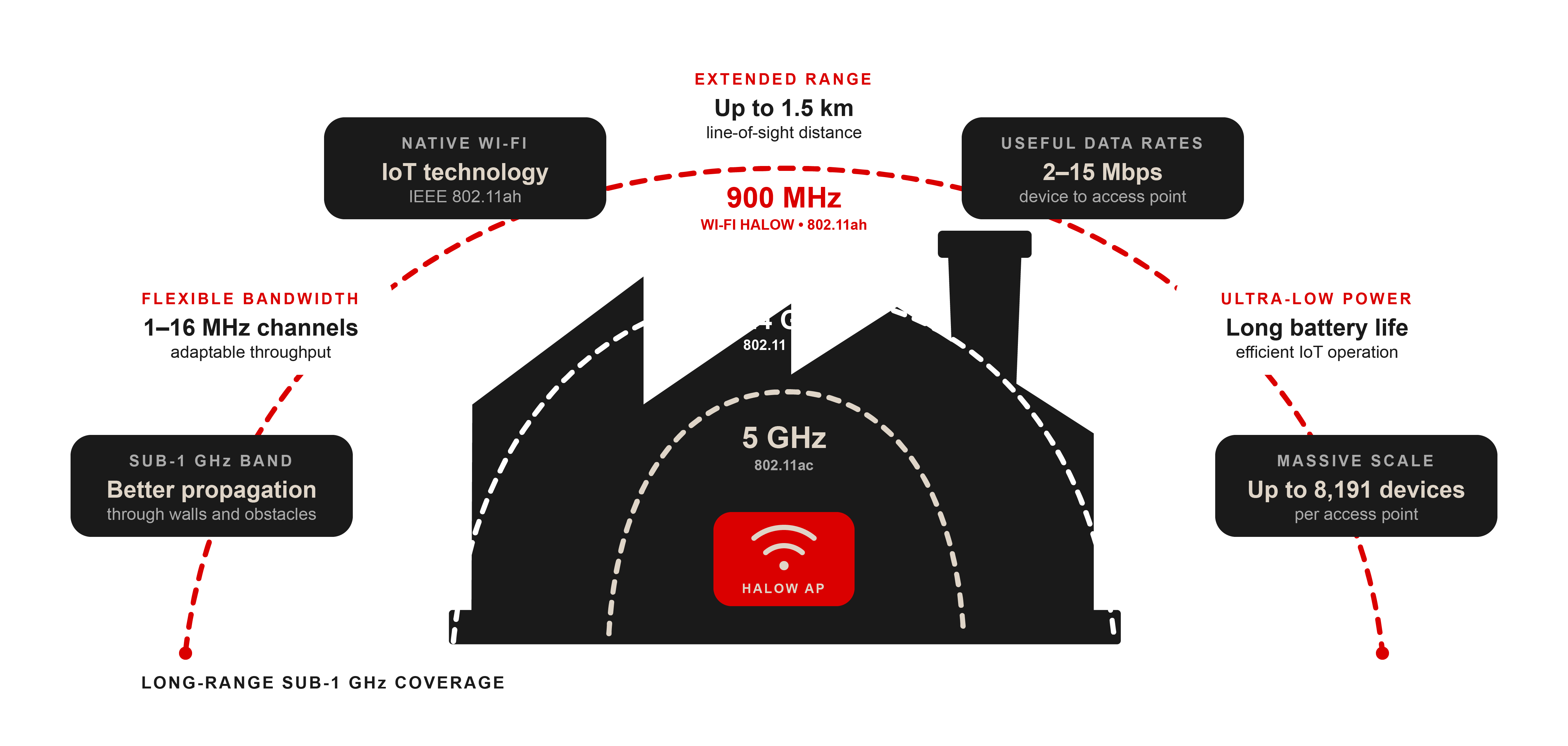
Wi-Fi HaLow is the Wi-Fi Alliance certification program for IEEE 802.11ah. Standard Wi-Fi uses 20 MHz channel, while HaLow narrows this to as little as 1 MHz. Narrower channels and lower path loss at sub-GHz frequencies give HaLow much better link margin so it reaches farther and through more obstacles than standard Wi-Fi.
HaLow does not replace 2.4 GHz Wi-Fi or Bluetooth; it fills the gap between short-range high-throughput links and long-range low-rate LPWAN.
| Features | Benefits |
|---|---|
| Sub-1 GHz Spectrum | Long range (1 km) + through walls |
| High Device Density (8,191) | Connects an entire site from one access point |
| Device Power-Saving Modes | Runs for years on a single coin-cell battery |
| WPA3 Wi-Fi Security | Enterprise-grade protection |
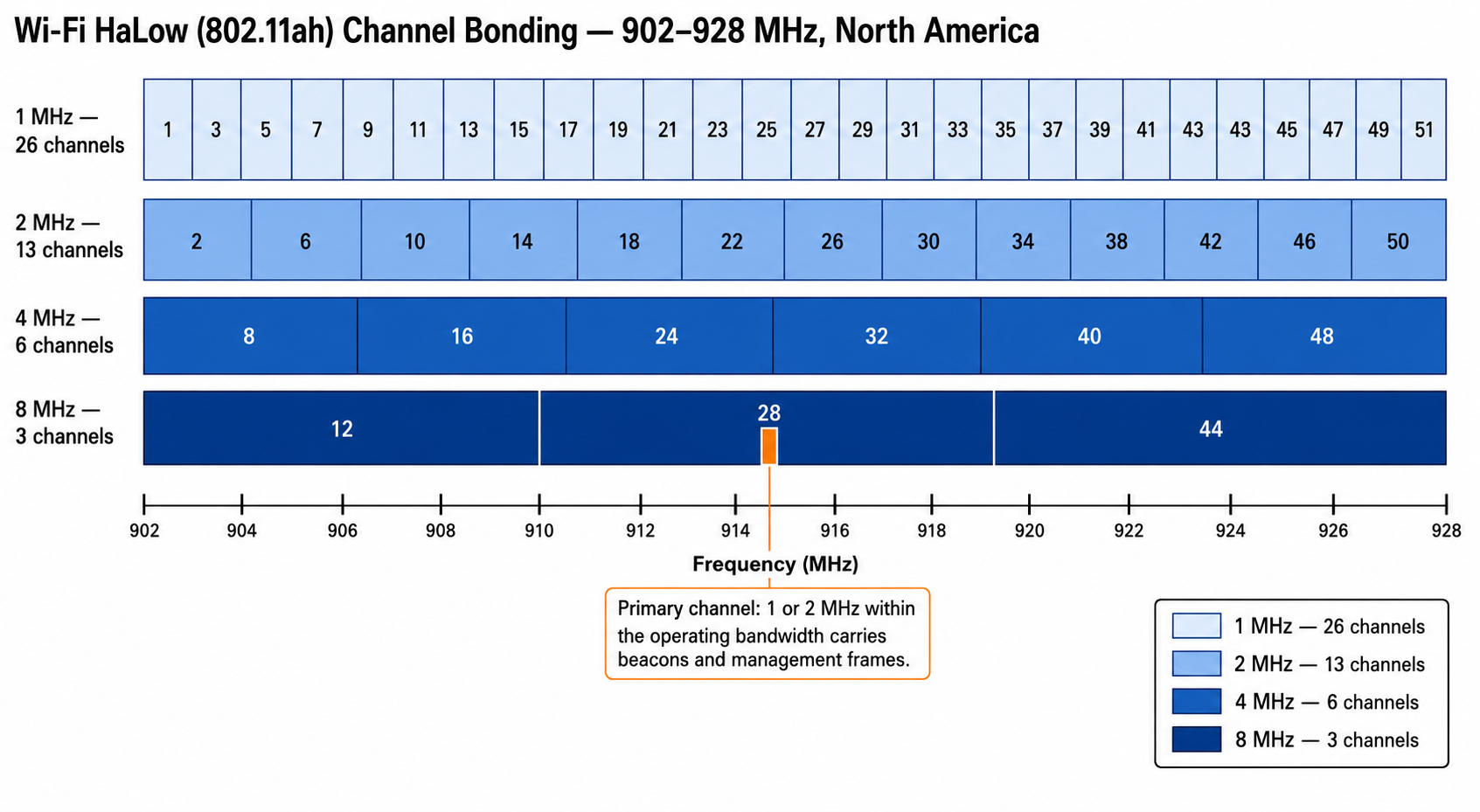
HaLow scales bandwidth to the job. A 1 MHz channel maximizes sensitivity and range for sensors sending kilobytes per hour; an 8 MHz channel supports video and firmware updates at tens of megabits per second. A single deployment can mix both, letting distant nodes fall back to narrow channels while nearby devices run wide.
RAW divides channel access into time slots assigned to groups of stations, which prevents the collision storms that occur when thousands of devices attempt to associate or report simultaneously. This is what makes the 8,191-device ceiling practical rather than theoretical.
TWT lets an access point and a station negotiate exactly when the station will wake to transmit or receive. Between those windows the radio sleeps at microamp-level current. For a sensor reporting every fifteen minutes, TWT is the difference between months and years of coin-cell operation.
At 1 MHz, HaLow adds a 2× repetition modulation scheme that trades data rate for roughly 3 dB of additional sensitivity. It extends usable coverage at the edge of a network, where a link that would otherwise drop stays connected at reduced throughput.
Wi-Fi 7 (IEEE 802.11be), the latest generation of Wi-Fi, builds on the foundation of Wi-Fi 6 and Wi-Fi 6E with major improvements in speed, latency, capacity, and efficiency. All three are part of...
/filters:background_color(white)/2025-07/IF9121.png)
Ultra low power connectivity for your next industrial IoT design
/filters:background_color(white)/2025-03/wifi-halow.png)
Explore the important attributes, benefits, and real-world uses of Wi-Fi HaLow that stand poised to transform connectivity across multiple industries, establishing it as a crucial component for contemporary technological advancements.