Choosing the Right Processor for Your Next Product: i.MX 95 vs. MediaTek Genio

The right processor decision made early is one of the most valuable investments you can make in a product development program. We're ready to help you make it.

Published on May 7, 2026

Choosing the Right Processor for Your Next Product: i.MX 95 vs. MediaTek Genio

One of the most important decisions you'll make in any product design is processor selection. Get it right and you get to build on a processor that can do everything your product needs to. Get it wrong, and you spend the half of your development cycle working around limitations that no amount of software can fully fix.

At Ezurio, we work with engineers across medical, industrial, commercial, and edge AI markets every day. We carry SMARC SOMs built on both NXP's i.MX 95 and MediaTek's Genio 510 and 700 processor families for a reason. They're different tools designed for different jobs. This post is our breakdown of both: where each excels, where each falls short, and how to think through the decision for your specific application.

Two Strong Platforms, Two Different Philosophies

Before you look at a single specification, it helps to understand the design behind each processor family.

NXP's i.MX 95 was designed for applications where the computing environment has hard requirements like real-time determinism, safety certification, industrial longevity, and great security. It's a heterogeneous processor: 6x Cortex-A55 microprocessor, 1x Cortex-M7, and a Cortex-M33 to run multiple Linux instances. When NXP's engineers designed the i.MX 95, they were thinking about factory automation controllers, medical instruments, and industrial HMI panels that need to run reliably in demanding environments for a decade or more.

MediaTek's Genio 510 and 700 were designed for products where multimedia performance and user experience are the primary drivers. Big Cortex-A78 application cores, a powerful GPU, high-TOPS AI acceleration, and a flexible display pipeline. MediaTek built these processors for smart displays, intelligent cameras, Android-based kiosks, and IoT devices where the product experience is rich and interactive.

What Each Platform Does Best


The Case for i.MX 95 (Ezurio Nitrogen95 SMARC)

The i.MX 95's capability is something that's easy to overlook in a spec comparison: it runs three independent processing domains simultaneously, each hardware-firewalled from the others. 

You have 6x Cortex-A55 application cores running your Linux or Android user interface. You have a Cortex-M7 microcontroller running a real-time operating system, motor control, or field-bus communications without ever being interrupted by OS scheduling. And you have a Cortex-M33 acting as a system manager, monitoring power, safety, and system integrity independently of both. 

This matters for a specific class of product: anything that needs to be both intelligent and reliable. Think of an industrial panel controller that shows process data on a touchscreen while simultaneously running EtherCAT communications to servo drives. Or a medical device that handles a clinical UI while also capturing sensor data at specific intervals. These aren't use cases you can solve by "just running the real-time task as a Linux thread." The hardware isolation on the i.MX 95 is doing something that software prioritization genuinely cannot do. 

Beyond the architecture, the i.MX 95 brings a security protocol that is in a different category from standard embedded processors. NXP's EdgeLock Secure Enclave is a dedicated hardware security subsystem that handles secure boot and key storage in a way the application processor cannot tamper with. It also supports Post-Quantum Cryptography from boot time, which matters for long-lifecycle product that needs to maintain security certifications well into the future. 

And if your product needs to go through a functional safety certification process like IEC 61508 SIL-2 or ISO 26262 ASIL-B, the i.MX 95 and NXP's SafeAssure framework gives you a documented path. That's not something you can retrofit onto a processor that wasn't designed for it.

The i.MX 95 is the right choice when:

  • Your design has real-time control requirements alongside a rich application OS
  • You need safety certification support
  • You're building for industrial, medical, or security-sensitive markets
  • Long-term product lifecycle (10+ years) and supply commitment matter
  • Your security requirements include hardware root-of-trust or QNX support

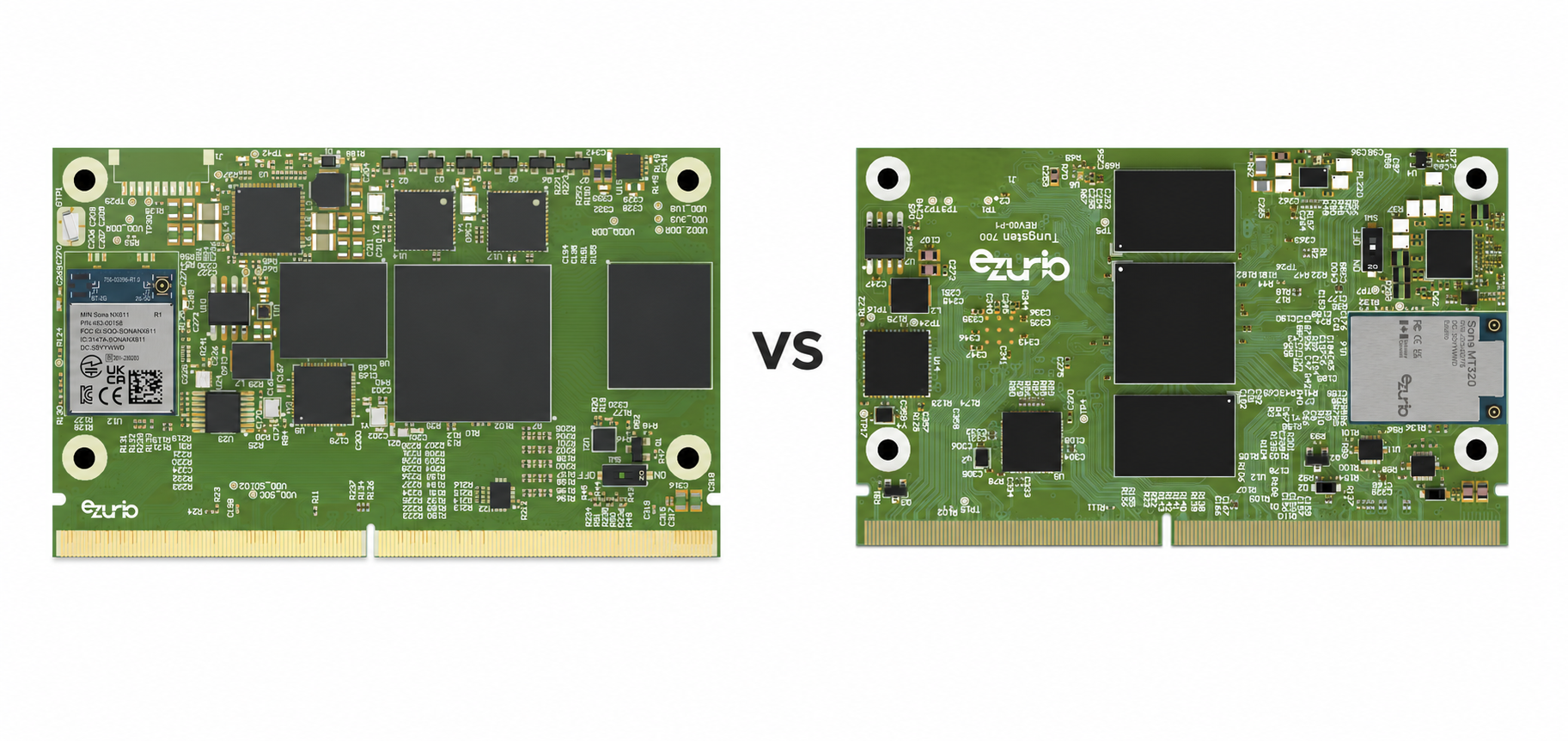
Ezurio's Nitrogen95 SMARC SOM product family. 

Order samples and our evaluation kits now to get started on your design.

N959_6_SMARCwith NX611 - front connector removed_4.png

The Case for MediaTek Genio 510/700 (Ezurio Tungsten510 and Tungsten700)

Where the i.MX 95 wins on depth and reliability, the Genio family wins on multimedia performance and user experience.

The Cortex-A78 cores in the Genio 500 and 700 are more powerful than the Cortex-A55 cores in the i.MX 95. The A78 has a higher per-core performance. For applications where UI responsiveness, smooth animation, and fast compute matter, the Genio family shows up. Your Android UI will be better. Your machine learning inference will return results faster. Your 4K video playback will be handled more efficiently.

The Genio 700 in particular delivers 4.0 TOPS of AI acceleration through MediaTek's neural processing unit. For on-device edge AI like object detection, face recognition, anomaly detection from image data, that allows you to run more sophisticated models, at higher frame rates, than the i.MX 95's 2 eTOPS NPU.

The display pipeline on the Tungsten SOMs is also more flexible for consumer-related products. HDMI 2.0, DisplayPort, and dual MIPI-DSI are all available, which covers a wider range of commercial display hardware. If you're designing a product that needs to connect to an off-the-shelf commercial display or a customer's existing monitor, the HDMI output matters.

And from a software perspective, if Android is your operating system, the Genio family's BSP is an advantage. MediaTek has deep Android experience, the drivers are well-suited, and you'll spend less time fighting BSP issues during bring-up.

The Genio 510/700 is the right choice when:

  • Your product is Android-first and user experience is the primary value driver
  • On-device AI inference performance is a key differentiator
  • You need HDMI output from the SOM
  • Your application is multimedia-heavy: 4K video, high-frame-rate camera, 3D UI
  • You don't have much functional safety requirements

Ezurio's Tungsten SMARC SOMs product family. 

Order samples of the Tungsten700 and Tungsten510 now to get started on your design.

Tungsten 510 - MT320 M2.2-1420 - Front.png

Key Specs Side by Side


Nitrogen95 i.MX 95 Tungsten700 Genio 700 Tungsten510 Genio 510
Processing
CPU cores 6× Cortex-A55 @ 1.8 GHz + Cortex-M7 @ 800 MHz (real-time) + Cortex-M33 @ 333 MHz (system manager) 2× Cortex-A78 @ 2.2 GHz
+ 6× Cortex-A55 @ 2.0 GHz
2× Cortex-A78 @ 2.0 GHz
+ 4× Cortex-A55 @ 2.0 GHz
AI / NPU 2 eTOPS*
eIQ Neutron NPU
4.0 TOPS 3.2 TOPS
Memory & Storage
RAM options Up to 16 GB LPDDR5 Up to 8 GB LPDDR4 Up to 8 GB LPDDR4
Storage 16 GB eMMC 16 GB eMMC 16 GB eMMC
Display & Multimedia
Display outputs 1× MIPI-DSI (4K30)
+ 2× LVDS (1080p60)
2× MIPI-DSI
+ HDMI 2.0 + DisplayPort
2× MIPI-DSI
+ HDMI 2.0 + DisplayPort
HDMI No Yes Yes
Video decode 4K60P H.265 / H.264 4K75 H.265 / H.264 / AV1 / VP9 4K60 H.265 / H.264 / AV1 / VP9
Camera / ISP 2× MIPI-CSI, 500 MP/s ISP 2× MIPI-CSI, 32 MP @ 30 fps ISP 2× MIPI-CSI, 32 MP @ 30 fps ISP
Connectivity
Ethernet 10 GbE + 2× TSN GbE 2× standard GbE 2× standard GbE
PCIe 2× Gen3 (8 Gbps total) 1× Gen2 1× Gen2
CAN-FD 2x
USB 2× USB 3.1 + 3× USB 2.0 2× USB 3.0 + 2× USB 2.0 + OTG 2× USB 3.0 + 2× USB 2.0 + OTG
Security
Security EdgeLock Enclave + PQC Standard secure boot Standard secure boot
Software
OS support Linux / Android / QNX / FreeRTOS Linux / Android Linux / Android
Best Suited For
Primary markets Industrial • Medical • Secure IoT • Commercial • Food & Beverage IoT • Industrial • Food & Beverage

Where These Processors Excel: Application by Application

Industrial HMI

Processor: i.MX 95

The M7 runs your control loop. The A55 cluster runs your HMI. Neither interferes with the other. Native CAN-FD and TSN Ethernet included

hmi-icon.png

Medical Devices

Processor: i.MX 95

EdgeLock Secure Enclave for patient data security. NXP's 15-year supply commitment matches medical device regulatory lifecycles

icon-ultrasound.png

Digital Signage

Processor: Genio Family

A78 cores and an Android BSP make kiosks feel fast. 4.0 TOPS NPU handles camera analytics. HDMI connects directly to commercial displays

icon-video.png

Vision Systems

Processor: Ask Us First

If your system needs a guaranteed response time after image capture, that's the i.MX 95. If inference throughput and resolution are the priority, that's the Genio 700. The requirements determine the answer.

machine-vision-icon.png

Robotics

Processor: Often i.MX 95

Navigation, motor control, and safety must run independently of each other. The i.MX 95's hardware domain isolation ensures they do regardless of what the Linux stack is doing.

icon-downtime.png

Smart Home

Processor: Genio Family

Responsive Android UI, Wi-Fi 6 + Bluetooth, capable edge AI. When you don't have real-time or safety requirements, the Genio family hits the right balance of performance and cost.

smart-sensor-icon.png

Why Ezurio

There are other SOM vendors who carry i.MX 95 or Genio-based modules. The reason engineers choose Ezurio comes down to a few things that are genuinely hard to replicate. 

We carry both families, and we're not incentivized to steer you toward one. When you talk to our applications engineering team, you get an honest assessment of which platform fits your product. 

EZ BSP: a secure software package, not just board support . Most SOM vendors ship you a BSP and leave the security architecture to you. EZ BSP is different. It's a production-ready, security-first software platform built specifically for Ezurio SOMs. It includes hardware root of trust provisioning, verified secure boot, signed image compilation, and OTA update capability with integrity protection. For engineers building in medical, industrial, or IoT markets where security is a product requirement rather than a feature, EZ BSP removes the difficulty of building that foundation yourself and significantly reduces the risk of vulnerabilities reaching the field. 

Our wireless certifications are yours to use. Our Sona™ wireless modules carry modular FCC, IC, CE, and other regional approvals. When you design with a Tungsten or Nitrogen95 SOM, you inherit those certifications for the radio. For global product launches, that difference can represent months of schedule andp tens of thousands of dollars in regulatory testing costs. 

US-based manufacturing with global capability. All three SOMs are assembled in the USA. For customers with supply chain sensitivity, ITAR adjacency, or a preference for domestic manufacturing, that's a real option. As your volumes grow and geographic needs change, our global manufacturing capability scales with you. 

Our applications engineering team has hands-on experience with i.MX 95 configuration, Genio BSP bring-up, SMARC carrier board design, and the integration challenges that come up between SOM and system. When you hit a problem at a critical point in your timeline, the difference between a vendor who can actually help and one who opens a support ticket shows up directly in your schedule.

Where to Start

If you're in early-stage product definition and not yet certain which platform fits, that's the right time to talk to us. We can walk through your requirements, help you identify where the tradeoffs are for your specific application, and get you to an evaluation kit that matches your actual use case.

Our Nitrogen95 SMARC evaluation kit includes a 7-inch display, optional 8.3MP camera, and a carrier board with the full range of interfaces exposed. Our universal SMARC carrier board supports both the Nitrogen95 and the Tungsten SOMs, so you can evaluate both platforms on the same hardware if your requirements have you sitting between them.