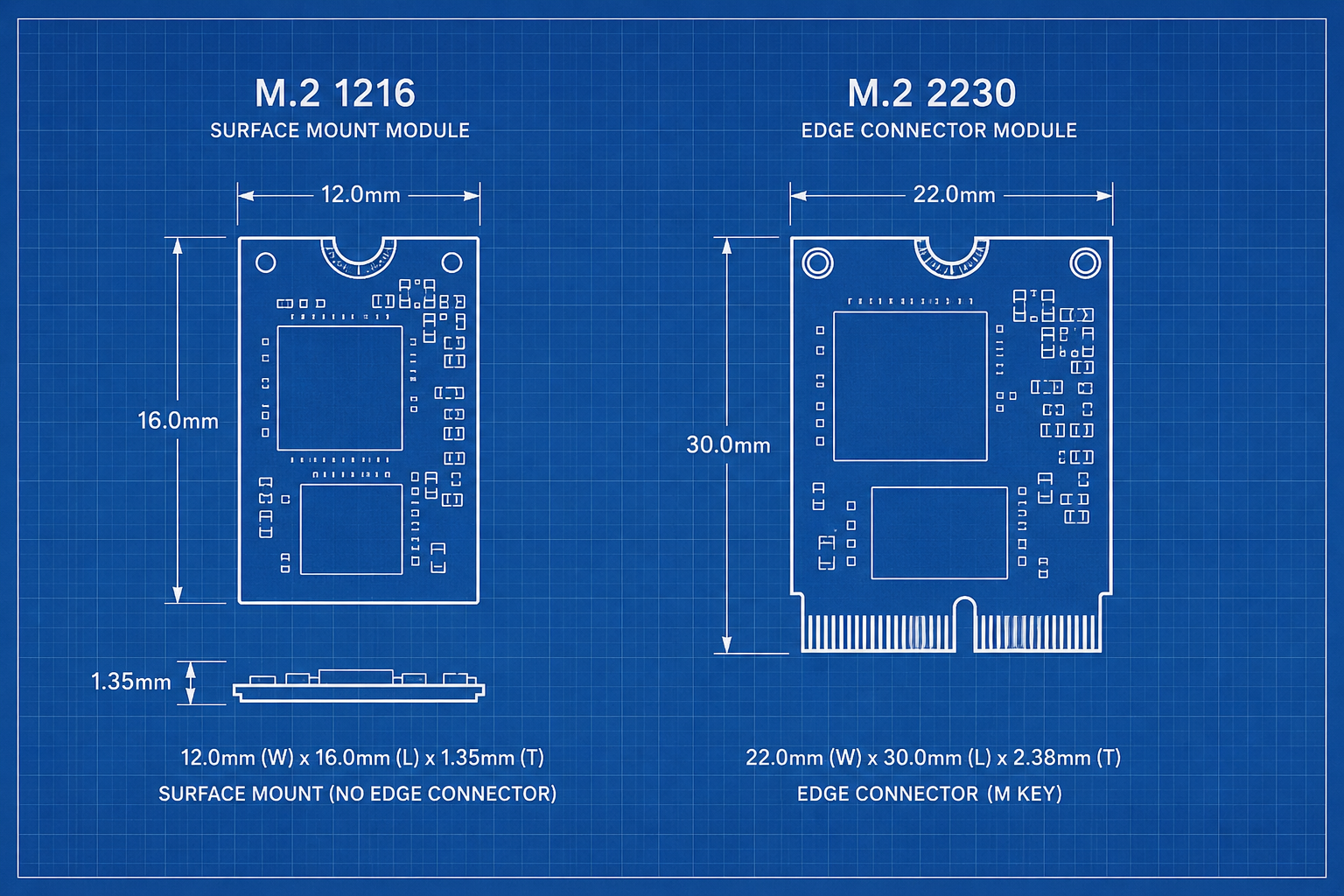
- Form factor and mechanical dimensions M.2 modules are identified by a four- or five-digit code where the first two digits indicate width (mm) and the remaining digits indicate length (mm). Common sizes include 2230, 2242, 2260, 2280, and 22110. Width is typically 22 mm, with lengths ranging from 30 mm to 110 mm. The standard also specifies single-sided (S1–S3) and double-sided (D1–D5) component height profiles, which dictate how thick the components on each side of the PCB can be — important for fitting modules into thin laptops, NVMe enclosures, or industrial systems.
- Connector and edge fingers M.2 modules come in either SMT or edge-connector form factors. Surface mount modules include the M.2 type 1216 and 1218, with a land grid array package. Edge connector modules use a 67-pin edge connector with a 0.5 mm pitch. Modules have one or more keying notches (keys A through M) cut into the edge connector that physically prevent insertion into incompatible host sockets. The most commonly encountered keys are B (for SATA/PCIe x2 SSDs, USB, and WWAN), M (for PCIe x4 NVMe SSDs), and A/E (for Wi-Fi/Bluetooth combo modules).
- Electrical interfaces A single M.2 slot can carry multiple interfaces over its pins, depending on host and module support: PCIe (up to x4 for M-keyed slots), SATA, USB 2.0/3.x, I²C, SDIO, UART, PCM audio, and display interfaces such as DisplayPort, depending on key type. The keying system tells the host what protocol set to expect.
- Power The connector supplies 3.3 V to the module. Power consumption ceilings vary by module class, with allowances for higher-power SSDs and lower-power wireless modules.
- Thermal and labeling considerations While M.2 itself is primarily mechanical/electrical, the spec addresses height budgets that constrain heatsink design, and specifies module labeling and identification conventions.
More Than Sizes & Pinouts: Why M.2 Standards Matters
The M.2 standard provides a consistent, predictable packaging for embedded hardware. Standardization has a long record of providing significant advantage in markets and technology where it has been applied, and created an inescapable advantage when looking at the long tail of product lifecycle design.
Published on May 6, 2026
M.2 Standards – Overview
In a previous blog post, we discussed the many M.2 standard footprints (also known as the Next Generation Form Factor [NGFF]) established and maintained by the PCI-SIG. The M.2 standard is meant to define more than purely sizes and pinouts. More broadly, it’s meant to define a well-performing embedded platform in terms of mechanical design, thermal performance, and electrical characteristics. It’s not just another shape, layout, and fit. It’s about reliability and best practices that any manufacturer can leverage into their designs. That includes:
While the standard was initially designed to support PC peripherals like wireless cards and solid state drives, replacing the widely used mini PCIe card format, the standard has become very popular for smaller-scale embedded computing. These are the devices that we’re focusing on in this blog post, in particular the M.2 1216 SMT, M.2 1218 SMT, and M.2 2230 pluggable form factors. These are the M.2 formats that apply to the embedded applications that Ezurio’s customers serve, and it’s where we’ve dedicated our engineering efforts and our roadmap to help customers integrate wireless now and in the deep future of their products’ lifecycles.
The M.2 standard has many advantages as the platform for embedded wireless. The hardware layer itself is optimal for these small-scale designs, providing resilience and performance from an RF architecture and environmental perspective. Our offering of both SMT and pluggable M.2 modules has important implications for future design refreshes down the line. And beyond any individual designer or manufacturer, the philosophy of standardization in this space will benefit embedded designers broadly, leveraging a shared approach as a tide that raises all boats.
1. M.2 Hardware Ruggedization vs. Future Flexibility
As with so many design decisions, choosing your wireless hardware has to be informed by your application’s requirements, real-world operating conditions, free space on your host PCB, and your plans for future design refreshes.
Ezurio’s approach allows OEMs to integrate the leading Wi-Fi chipsets from the industry’s biggest silicon providers in the form factor that best suits their specific requirements. From a purely hardware perspective, a big part of that alignment comes from the ability to provide an M.2-standardized pathway to integrating chipsets typically found on larger RF modules.
Each of our Wi-Fi radio families has its own M.2 1216 and/or 1218 wireless modules, the portfolio features the same RF chipset makes it available in their corresponding larger M.2 2230 pluggable format. This means OEMs don’t have to compromise the full core RF offering to integrate a much smaller footprint into their designs.
And it’s not just a smaller footprint that OEMs are looking for in this process. The surface mount nature of M.2 1216 and 1218 provides a rugged integration that is critical in many designs. Whether it’s resistance to vibration, dust, or shock, a solder-down package provides a validated reliability and durability that can’t be perfectly replicated with a pluggable module. Thermal characteristics play a factor too: a pluggable design might offer better thermal performance due to the open air around the connected module, but possibly a more vulnerable design in terms of mechanical and shock/vibration characteristics.
This IS a trade-off, the importance of which can’t be understated. If your operating conditions are less extreme and your device is likely to be in the field for a decade or more, M.2 2230 plug-in modules offer something the others don’t – an in-field upgrade path for future refreshes. It’s much easier to replace pluggable RF modules in the field when it’s time for a wireless upgrade, without the expensive and risky design rework of desoldering and reflowing a new module onto a legacy board. This may be well worth sacrificing some ruggedization in devices that operate in relatively comfortable environments (think medical equipment, fixed-placement sensors and gateways, indoor operation and clean air). Especially for those designs that live in the field for decades, the M.2 2230 path may prove an attractive prospect for future proofing.
2. RF Performance and Antenna Integration
As previously mentioned, M.2 SMT modules have the advantage of providing the very same core chipset and RF hardware as their larger 2230 counterparts. This is core to Ezurio’s value of giving OEMs flexibility in their designs, allowing space-constrained designs to leverage full radio performance. Towards that goal, we also add integrated chip antenna options on those very same M.2 1212 and 1218 variants, further expanding what is possible.
Within the M.2 specification there is freedom to select your preferred antenna configuration, including on-module connectors, RF pins, or an on-board antenna, while maintaining the core compatibility between devices. Ezurio brings the same flexibility in the products we supply while providing the optimized RF performance an on-module antenna path can bring. Although each device’s RF path may differ from the others, the consistency of antenna connection or on-board antenna placement leverages further compatibility when looking to move from one device to the other. This means there’s no need to redesign the RF path or antenna placement in your end product when switching modules.
/filters:background_color(white)/2025-12/Sona%20NX611%20-%20Family.png)
/filters:background_color(white)/2024-04/Sona%20TI351%20-%20Family%20%281%29.png)
/filters:background_color(white)/2026-02/IF7x3%20Series%20-%20Mockup%20-%20logo.png)
/filters:background_color(white)/2024-10/Sona%20IF573%20-%20Family.png)
/filters:background_color(white)/2024-03/Sona%20IF513.png)
/filters:background_color(white)/2024-03/Sona%20MT320%20Family%281%29.png)
3. The Real Value of Standards-Based Designs
This last point is both pragmatic and philosophical, and it gets to the core of Ezurio’s vision and mission of enabling our customers to excel. There are all kinds of proprietary offerings available in the embedded hardware space. Manufacturers provide wireless hardware, software, and firmware designed to address specific needs, provide particular functionality, all presumably to the benefit of customers and to create unique value. But Ezurio believes that contributing to the growth and adoption of common standards provides an even greater value, not just for ourselves or our customers but for entire industries.
You only have to look in your junk drawer to see the legacy effects of manufacturer-specific hardware confusion. Take for example the countless types and varieties of data and charging cables that used to plague the electronics people used every day. There was a time when every phone manufacturer had their own proprietary charging port, when every device in your home might have a differently sized barrel jack with a different voltage. Every printer or monitor or media drive might have its own variety of serial cable, largely incompatible with each other. Without robust common standards, every manufacturer has to procure their own solution. Some are less ideal than others.
For those designing wireless into their systems, a similar problem exists. Choosing one form factor over another has consequences for the future. If that interface is no longer available in the future, a design re-spin becomes necessary to fit a new one. Even if that interface continues to be available for decades, you’re now locked in with the vendors that support that package. It leads OEMs to sacrifice on possibility, and in an evolving industry, Ezurio doesn’t believe that this fragmentation is something that customers can afford to take on .
Your wireless solution that suits your customer and application needs today may not be sufficient in the future. Requirements change as your application expands and as your customers’ expectations shift. This is another core advantage to designing in a standardized form factor: flexibility around performance and cost. If you need a more powerful or more up-to-date wireless chipset in your design, you can integrate a different module to your new production without spinning a new hardware design. If you feel you can sacrifice some complexity and performance, you can opt for a lighter, more inexpensive offering that cuts your costs and improves your margins. All of this comes without additional design work, and the standard form factor means you can be confident that package will be available in a decade when you need it.
These are some of the reasons why our connectivity and compute solutions are based on industry-established standard footprints adopted by leaders in the embedded design space. They are the result of years and years of careful consideration by experts, leveraging best practices with the goal of providing open, transparent frameworks for tomorrow. They do not serve just a single manufacturer or just one set of specific features. They demonstrate forward thinking by seasoned engineers looking at the needs of the future.
It’s the same reason Ezurio partners with dozens of companies in our space on similarly open-sourced offerings and a diverse array of providers. We offer wireless hardware from a large selection of the leading silicon providers. We partner with the Linux foundation and offer software for many of the most popular distributions to give our customers flexibility. We’re members of the standards boards for the IEEE, Bluetooth SIG, PCI-SIG, the LoRa Alliance, the Wi-Fi Alliance, and the Zephyr Foundation. We offer support and compatibility for proprietary software architectures and solutions as well, but our philosophy is straightforward. We believe what benefits the industry benefits every single participant. Our hardware and software portfolio illustrates a commitment to that belief and an attempt to move the entire wireless and embedded compute space forward.
To learn more about our line of Sona Wi-Fi + Bluetooth modules, featuring silicon from Infineon, Mediatek, NXP, Silicon Labs, and Texas Instruments, visit our website:
https://www.ezurio.com/wifi
Resource Center
-
/filters:background_color(white)/2024-10/Sona%20IF573%20-%20Family.png)
How to Choose the Right Wi-Fi Module for Your IoT Application
In this article, we delve into the technical aspects, potential challenges, and the future prospects of Wi-Fi technology in IoT applications.
-
/filters:background_color(white)/2026-02/IF7x3%20Series%20-%20M.2%20Mockup.png)
Industry Standard M.2 Footprints Explained
What Every Engineer Needs to Know Before Designing In a Wi-Fi Module
-
/filters:background_color(white)/2025-02/wifi7_d.png)
The Benefits of Wi-Fi 7
Designed to meet growing demands for bandwidth-intensive and real-time applications, Wi-Fi 7 brings a host of benefits that make it a truly next-gen Wi-Fi experience.
-
/filters:background_color(white)/2026-02/connected_warehouse_wp_cover.png)
Upgrading a Connected Warehouse With Embedded Wi-Fi
By combining Infineon's proven AIROC wireless silicon with Ezurio's expertise in module design, OEMs can deliver more efficient equipment tailored to the decades long life cycles required in the industrial market.
-
/filters:background_color(white)/2025-02/icon-pain-security.png)
Wi-Fi Security Protocols: Explained
Wi-Fi has become the backbone of modern industrial and IoT networks, but its convenience comes with security challenges. Protecting wireless data from eavesdropping and unauthorized access is...