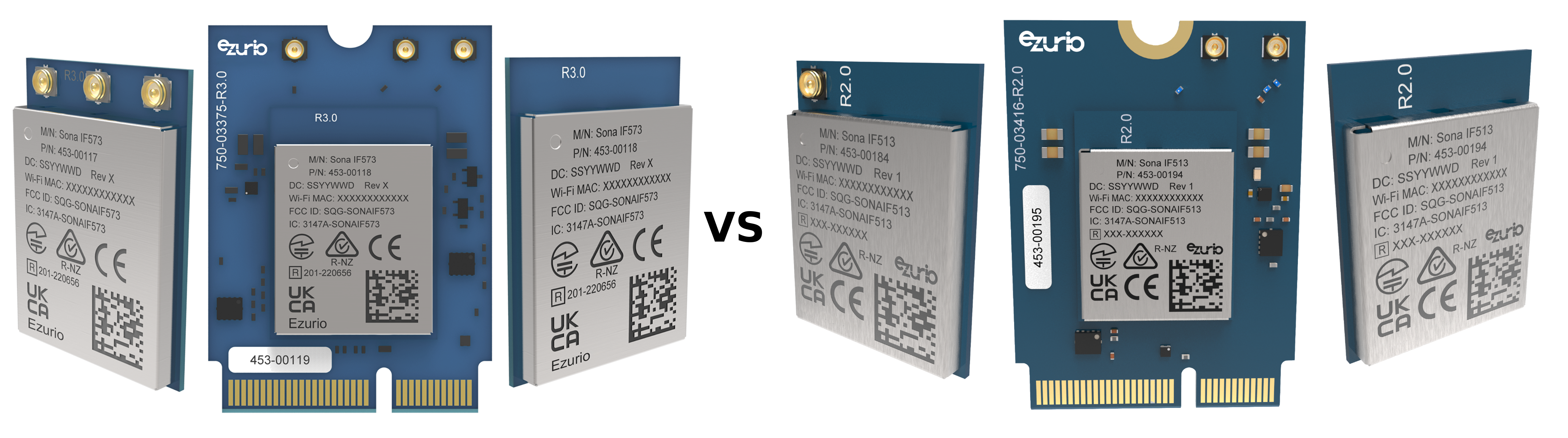
Sona™ IF573 vs. Sona™ IF513: Performance vs Low Power
Wi-Fi 6E Module Selection: When Each Wins
Published on April 13, 2026
Picking a Wi-Fi 6E module by leading with the spec sheet is backwards. Engineers who start with "what does this radio support?" end up over-specifying battery-powered devices or under-specifying high-density infrastructure nodes and those mismatches surface in late-stage integration, not early architecture. The right question is "what does my application actually demand?" and then matching the module to those demands.
Ezurio's Sona™ product line includes two Wi-Fi 6E modules built for the same industrial temperature range, the same 802.11ax standard, and the same global certification footprint, but tuned for fundamentally different deployment contexts. The Sona™ IF573 is the performance platform: highest throughput, PCIe host interface, 2x2 MU-MIMO. The Sona™ IF513 is the low-power platform: 1x1 antenna architecture, 20 MHz channel support, SDIO host interface, smallest M.2 1216 form factor, antenna diversity support. Both carry Wi-Fi 6E capability across 2.4, 5, and 6 GHz. The engineering decision between them turns on four variables: throughput ceiling, power budget, host interface, and form factor. Getting that decision right before you commit your PCB design is the purpose of this article.
The Hardware Layer: IF573 and IF513
The specification describes what both modules can do. The hardware architecture determines which of those capabilities your application can actually use, at what power cost, and in what physical footprint.
| Specification | Sona™ IF573 | Sona™ IF513 |
|---|---|---|
| Primary designation | High performance | Low power |
| Antenna configuration | 2x2 MU-MIMO | 1x1 MU-MIMO |
| Channel bandwidth | 20 / 40 / 80 MHz | 20 MHz |
| Wi-Fi host interface | PCIe Gen 2 (3.0 compliant) + SDIO 2.0/3.0 | SDIO 2.0/3.0 |
| BT host interface | HCI-UART, PCM/I2S | HCI-UART, PCM/I2S |
| Bluetooth version | BT 5.4 (Long Range) | BT 5.4 (Long Range + LE Audio) |
| Form factor | M.2 1318 / M.2 2230 | M.2 1216 / M.2 2230 Type E |
| Antenna options | MHF, RF trace pin | Single MHF, Dual MHF (diversity), RF trace pin |
| Operating temperature | -40°C to +85°C | -40°C to +85°C |
| Certifications | FCC, IC, CE, MIC, UKCA, BT SIG | FCC, IC, CE, MIC, UKCA, RCM, BT SIG |
The PCIe vs. SDIO Interface Decision
This is the choice with the deepest downstream architectural implications and the one most frequently underestimated.
The IF573 offers both PCIe Gen 2 (3.0 compliant) and SDIO 2.0/3.0 host interfaces. PCIe Gen 2 provides approximately 500 MB/s theoretical host bandwidth per lane, more than sufficient to sustain the IF573's peak Wi-Fi throughput at 2x2 on 80 MHz channels. For applications running continuous high-throughput streams (AI video analytics pipelines, medical imaging data offload, PCIe-attached compute platforms), this matters. PCIe also enables DMA transfers that reduce CPU load on the host processor during sustained data movement.
The IF513 is SDIO-only. SDIO 3.0
supports up to 104 MB/s theoretical bandwidth in UHS-I mode, adequate for the
IF513's 1x1, 20 MHz operating envelope, but not extensible if requirements
change. SDIO is a simpler low pin count, lower-power bus, and its power characteristics are
well-matched to the IF513's low-power profile.
2x2 vs. 1x1: More Than a Peak Rate Difference
The IF573's 2x2 spatial stream configuration provides two material advantages beyond the doubling of theoretical peak PHY rate. First, transmit diversity: with two antennas transmitting, the IF573 can use beam selection and transmit beamforming to maintain link quality at range or through RF obstacles that a 1x1 radio would treat as link degradation. In environments like hospital corridors, factory floors with metal machinery, or multi-floor buildings, 2x2 produces more reliable sustained throughput, not just higher peak rates.
Second, MU-MIMO participation. The IF573 supports bidirectional MU-MIMO, meaning it can receive simultaneous spatial streams from the AP (downlink) and participate in uplink MU-MIMO scheduling. This is particularly relevant for applications that both upload and download significant data. An AI edge device pushing inference results upstream while pulling model updates downstream.
The IF513's 1x1 configuration with antenna diversity is a different optimization. Antenna diversity (supported via dual MHF connector configuration) uses receive-side switching to select the better antenna signal, not spatial multiplexing, but effective RF robustness mitigation. For a handheld industrial terminal or a sensor node that moves through a facility, diversity reception maintains link reliability through orientation changes without the power cost of a full 2x2 chain.
An additional important note is the impact of supporting either two antenna (2x2 and 1x1 diversity) or a single antenna (1x1). This changes cost as well as the mechanical requirements to implement depending upon the architecture. Often small form factor devices are unable to support more than a single antenna, this must be considered.
Form Factor and the Smallest Board Wins
The IF513 supports M.2 1216 (12mm × 16mm) footprint, that is smaller than the M.2 1318 (13mm × 18mm) form factor of the IF573's smallest configuration. For portable medical devices, handheld logistics terminals, and wearable industrial scanners where PCB real estate is constrained, the M.2 1216 option on the IF513 frequently determines feasibility. Both modules are also available in M.2 2230 (22mm × 30mm) for applications that prioritize RF performance and antenna clearance over miniaturization.
It is important to know that although the mechanical size differs between the IF573 and IF513 on the surface mount configuration, they both support exactly the same footprint to the PCB, means they are interchangeable if the 13mm x 18mm size is accounted for in the mechanical esign.
Practical Deployment Guidance: Which Module Fits Which Application
The following decision framework
maps application requirements to module selection. Apply it before committing
your schematics.
- Define your worst-case throughput requirement. If sustained peak rates exceed approximately 100 Mbps under peak channel conditions, or if you need 80 MHz channels for consistent high-bandwidth operation, select the IF573. Applications in this category include: medical imaging transfer (CT, MRI, ultrasound DICOM files), AI video surveillance with edge processing, high-density robotics with real-time vision feedback, and industrial automation platforms requiring concurrent sensor data and command streams. If data latency is important having a higher bandwidth can help reduce total data delivery time.
- Assess your power budget. If the device runs from a battery or energy harvester, and Wi-Fi is not continuously transmitting (sensor reporting intervals, intermittent command receipt, periodic data sync), the IF513 with TWT configured is the appropriate choice. Applications: portable medical analyzers, warehouse handheld terminals, UAV control links, field-deployed sensors. If the device is line-powered and Wi-Fi is always-on with continuous traffic, power budget is not the discriminating variable — move to throughput and host interface.
- Confirm your host SoC's available interfaces. If your host processor exposes only SDIO (common on cost-optimized embedded Linux SoMs and lower-end application processors and microcontrollers), the IF573's PCIe advantage is debatable, use the IF513. If your host exposes PCIe and your application demands high throughput, the IF573's PCIe interface is the correct path. Both modules support SDIO, so SDIO-only hosts are not a constraint on IF573 selection, but PCIe capability should be used when available for high-throughput applications.
- Consider your operating environment's RF characteristics. Dense environments with many co-channel devices (hospital ERs, factory floors with dozens of wireless nodes) benefit from the IF573's 2x2 MU-MIMO and bidirectional spatial stream capability. Mobile or orientation-variable devices benefit from the IF513's antenna diversity configuration, which handles signal variation without the power overhead of a full 2x2 chain.
- Factor in form factor constraints. If your PCB cannot accommodate M.2 1318 or M.2 2230, the IF513's M.2 1216 option may be the deciding factor. Check available keepout dimensions against your board layout constraints before finalizing module selection.
Both modules share the same pre-certified antenna ecosystem, the FlexMIMO 6E (EFD2471A3S-10MH4L), Mini NanoBlade Flex 6 GHz (EMF2471A3S-10MH4L), and FlexPIFA 6E (EFB2471A3S-10MH4L), all carrying FCC, IC, MIC, UK, and EU certification across both PIFA and PCB Dipole topologies. Using these pre-certified antennas with either module eliminates antenna-level re-certification, which can represent weeks of schedule risk in high-volume product development.
Regulatory and Certification Considerations
Both the IF573 and IF513 carry global regulatory certifications: FCC (Part 15), Industry Canada (IC), CE (RED Directive compliance for EU markets), MIC (Japan), and UKCA (post-Brexit UK market). The IF513 additionally carries RCM certification for Australia/New Zealand markets, a consideration for products targeting Asia-Pacific distribution without a separate Wi-Fi 6E certification effort.
The 6 GHz band regulatory landscape continues to evolve. The FCC's Part 15 Subpart E rules authorize indoor and standard power operation in the 6 GHz band, with AFC (Automated Frequency Coordination) required for standard power outdoor operation. The EU's Delegated Regulation (EU) 2021/1067 under the Radio Equipment Directive authorized the lower 6 GHz sub-band (5925–6425 MHz) for indoor low-power use. Japan's MIC authorization covers operation within the 6 GHz band under technical conformity mark requirements.
For products subject to IEC 62443 (industrial cybersecurity) or IEC 60601-1 (medical electrical equipment), the module's certified radio reduces but does not eliminate system-level compliance obligations. Both the Sona™ IF573 and IF513 support WPA3-Personal and WPA3-Enterprise authentication modes, which align with NIST SP 800-97 guidance on protecting IEEE 802.11 wireless networks, specifically the recommendation that enterprise Wi-Fi deployments implement 802.1X-based authentication and AES-CCMP encryption. WPA3-Enterprise eliminates the pre-shared key model entirely, replacing it with EAP-TLS or PEAP-based credential validation against a RADIUS infrastructure.
Conclusion
The Sona™ IF573 and Sona™ IF513 are not competing products, they are complementary tools for different engineering constraints. The IF573 wins when throughput, spatial stream capacity, RF robustness, and PCIe host bandwidth are the binding variables: medical imaging infrastructure, AI video edge nodes, high-density robotics platforms. The IF513 wins when power budget, form factor, and TWT-driven battery life are the binding variables: portable diagnostics, warehouse handheld terminals, UAV links, field sensors.
Both modules deliver the full 802.11ax feature set, 6 GHz spectrum access, industrial temperature operation, and the same pre-certified antenna ecosystem. The decision belongs at architecture, not at component selection. Define your throughput floor, power ceiling, host interface, and board dimensions first then match the Sona™ Wi-Fi 6E module to those requirements. Ezurio's Sona™ platform is designed to fit precisely into that engineering model, giving development teams the right radio for the right application without forcing a compromise between performance and power that shouldn't exist.
To discuss module selection for your specific application, contact Ezurio's engineering team at ezurio.com, or explore the full Sona™ Wi-Fi 6E product documentation to compare specifications in detail.
To learn more about the Sona™ IF513, visit www.ezurio.com/sona-if513
To learn more about the Sona™ IF573, visit www.ezurio.com/sona-if573