/filters:background_color(white)/2024-10/Sona%20IF573%20-%20Family.png)
How to Choose the Right Wi-Fi Module for Your IoT Application
In this article, we delve into the technical aspects, potential challenges, and the future prospects of Wi-Fi technology in IoT applications.
We break down what types of devices support Wi-Fi 7 (802.11be) as of 2024–2026, covering all major categories without speculating on unconfirmed models.
Published on April 15, 2026
Wi-Fi 7, formally known as IEEE 802.11be,
is the latest generation of Wi-Fi technology. It delivers extremely high
throughput (theoretical peaks up to tens of gigabits per second) along with
improved capacity and low latency using features like 320 MHz ultra-wide
channels, Multi-Link Operation (MLO), and 4096-QAM modulation. The Wi-Fi Alliance began certifying Wi-Fi 7 products in early 2024, signaling
official adoption of the standard.
Today, Wi-Fi 7 support spans a wide range of devices – from consumer
electronics to enterprise gear and industrial IoT endpoints – thanks to rapid
advances in chipsets and certification programs.
Below we break down what types of devices support Wi-Fi 7 (802.11be) as
of 2024–2026, covering all major categories without speculating on unconfirmed
models.
Wi-Fi 7 (802.11be) was published and ratified in July 2025 by the IEEE, but hardware production and rollout began many years earlier as the standard was being developed. Infrastructure silicon has been shipping since 2022, part of the natural progression of rolling out a new wireless standard. Infrastructure always precedes client devices and mass adoption, and this case is no different. But the rate of adoption of Wi-Fi 7 is not the same across device classes and applications.
As is often the case, the most rapid adoption of Wi-Fi 7 is occurring in consumer-focused devices where bleeding edge performance takes the front seat. Far and away leading the pack of Wi-Fi 7 integrations are laptops and tablets, with wireless home devices and desktop computers following behind. These early adopters are following closely behind the rollout of infrastructure, whereas other applications lag greatly. The overall Wi-Fi market is currently, on average, about 24 months behind the deployment of Wi-Fi 7 networks. In some markets, namely medical and industrial, the lag is even farther behind, about 36 months behind. The reasons for this are straightforward: new technologies in sensitive applications require more careful design consideration and are slower to reach the market.
Wi-Fi 7 adoption continues to grow from the point of those initial infrastructure applications in 2022. Integration progressed slowly until 2024, on track to double in 2026, and by expected to grow approximately 25% through 2027. However, not all device integrations are expected to ultimately adopt Wi-Fi 7. In fact, current estimates indicate Wi-Fi 7 adoption will reach a peak of around 60% of all Wi-Fi deployments by 2029, before modestly reducing by 2030. Across this time period, most other Wi-Fi standards are expected to almost mostly cease shipping, ending up with virtually all new Wi-Fi integrations being either 802.11be, 802.11ax, or 802.11ah (Wi-Fi HaLow).
Wireless routers and mesh systems were actually the first device category to widely support Wi-Fi 7. Several networking manufacturers announced Wi-Fi 7 routers based on draft standards as early as 2022, with retail units available by early 2023. These cutting-edge tri-band routers introduced Wi-Fi 7’s capabilities to home networks well before the standard was finalized. Today, a growing selection of Wi-Fi 7 routers is on the market, including standalone gaming routers and whole-home mesh Wi-Fi 7 systems. They typically feature 2.4 GHz, 5 GHz, and 6 GHz radios to support all bands, and often include multiple multi-gigabit Ethernet ports to handle the increased wireless throughput. Early models demonstrated over 10 Gbps of combined wireless capacity, and newer units continue to push performance. Mesh Wi-Fi 7 systems use the 6 GHz band or multi-link operation for high-speed wireless backhaul between nodes, improving coverage and stability in large homes. Given that Wi-Fi 7 routers are now Wi-Fi Alliance certified, prices have started to gradually come down from early-adopter levels. In summary, if you’re looking to create a home network that fully utilizes Wi-Fi 7 speeds, there are already many Wi-Fi 7 capable routers and mesh Wi-Fi kits available from leading brands.

Beyond the consumer space, enterprise networking equipment is rapidly adopting Wi-Fi 7 as well. Nearly all major wireless LAN vendors have introduced Wi-Fi 7 access points (APs) for business and campus environments. These enterprise-grade APs support the 2.4, 5, and 6 GHz bands simultaneously and are built to handle dense deployments. For example, one vendor’s new Wi-Fi 7 AP series offers enhanced capacity (supporting up to 12 spatial streams) and even includes dual integrated radios for Bluetooth LE and 802.15.4 (Zigbee/Thread) to better serve IoT devices in the enterprise. Such APs often have significant onboard processing and memory, enabling features like local containerized applications or advanced location services to run at the network edge. They are engineered to deliver ultra-reliable, low-latency wireless needed for mission-critical uses like wireless VR training, high-density conferencing, and real-time automation on factory floors. Businesses deploying Wi-Fi 7 infrastructure typically upgrade to multi-gig Ethernet switches and high Power-over-Ethernet budgets, since these APs can draw 30–40W and use multi-gig backhaul to handle the traffic loads. In summary, enterprise Wi-Fi 7 access points and controllers are now available from leading vendors, bringing the latest Wi-Fi standard into offices, campuses, hospitals, and industrial sites to support next-generation connectivity demands.

Laptops and PCs are also embracing Wi-Fi 7. The PC industry typically refreshes wireless adapters with each generation, and Wi-Fi 7 is becoming standard on new high-performance machines. Major processor vendors have integrated Wi-Fi 7 into their latest platforms – for instance, next-gen laptop CPUs in 2024 began including built-in Wi-Fi 7 connectivity as a default feature. One leading chipmaker reports that a “typical Wi-Fi 7 laptop” can achieve multi-gigabit wireless speeds (on the order of 5.8 Gbps in ideal conditions), roughly 2–3× faster than the peak rates of Wi-Fi 6/6E laptops. This has made Wi-Fi 7 standard on premium notebooks and gaming laptops launched in 2024–2025, often alongside support for the 6 GHz band and advanced antennas. Desktop PCs are not left behind either – enthusiasts can find Wi-Fi 7 PCIe add-in cards and motherboards with Wi-Fi 7 chipsets. In short, most new high-end laptops, 2-in-1s, and even desktops now offer Wi-Fi 7 compatibility, ensuring personal computing devices can take full advantage of the latest wireless networks without add-on dongles.

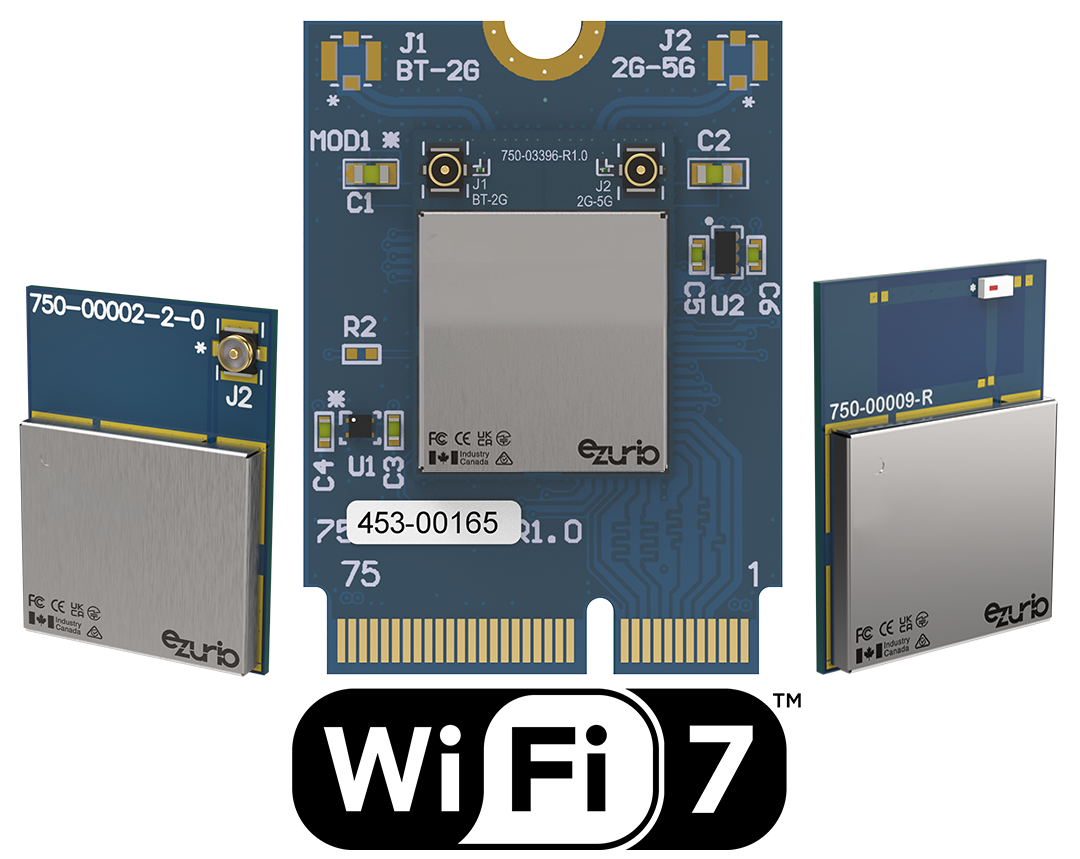
Introducing the first member of the Sona™ Wi-Fi 7 product line from Ezurio, the IF703 and IF713, based upon Infineon’s leading AIROC™ ACW741x chipset. A truly robust industrial IoT module: one that is low power, rugged, small, globally certified, has reliable connectivity, and is easy to integrate. It is purpose-built for industrial IoT connectivity with access to a SDIO Wi-Fi and UART Bluetooth host interfaces, industrial operating temp range, latest generation Wi-Fi and Bluetooth®, with an option for 802.15.4, combined with both pluggable card and SMT M.2 packaging.
Modern smartphones are among the early adopters of Wi-Fi 7. Flagship mobile chipsets introduced in 2022–2023 (for example, high-end 5G system-on-chips) began including Wi-Fi 7 radios, enabling handset makers to build Wi-Fi 7 capability into premium phones. By 2024, several flagship smartphones from leading manufacturers shipped with Wi-Fi 7 hardware on board. In some cases, the functionality was initially dormant pending software updates or certification, but the hardware support was present. This means if you bought a top-tier smartphone in late 2023 or 2024, it likely has Wi-Fi 7 compatibility (even if it required a firmware update to fully enable). Beyond phones, other mobile devices are following suit – advanced tablets and emerging wearable or XR devices are expected to adopt Wi-Fi 7 as well, especially to leverage its low-latency, high-bandwidth links for applications like AR/VR streaming and untethered high-definition media. Overall, the smartphone ecosystem is moving quickly to integrate Wi-Fi 7, ensuring mobile users can benefit from faster, more reliable connectivity as Wi-Fi 7 networks roll out.

One of the most exciting developments is Wi-Fi 7 expanding into IoT and industrial devices. Traditionally, many low-power IoT gadgets (sensors, wearables, smart appliances, etc.) could not take advantage of the newest Wi-Fi generations because they operate on narrow 20 MHz channels to save power. This is changing with Wi-Fi 7. In 2024, the Wi-Fi Alliance introduced a certification for 20 MHz-only Wi-Fi 7 devices, enabling even simple IoT clients to use core Wi-Fi 7 features despite narrow bandwidth. In practice, this means that new generations of smart sensors, fitness wearables, home security cameras, and other connected gadgets can be Wi-Fi 7 certified and reap benefits like greater efficiency and reliability on busy networks. On the industrial side, Wi-Fi 7 is poised to play a key role in factories, logistics, and healthcare settings. Its features such as multi-link operation and 4K-QAM modulation significantly boost reliability and throughput, which can be transformative for mission-critical IoT applications. For example, Wi-Fi 7’s ability to use multiple bands at once (MLO) can reduce latency and prevent dropouts – crucial for real-time automation and robotics – while 4096-QAM increases capacity fourfold compared to Wi-Fi 6, enabling high-bandwidth use cases like AI-driven manufacturing systems or wireless transfer of medical imaging data. Thanks to these advances, industry analysts project Wi-Fi 7 will move beyond just high-end routers and phones into a truly mass-market technology for smart homes, cities, and Industry 4.0 deployments. With new certifications and chipset support, expect to see Wi-Fi 7 connectivity in everything from household IoT appliances to industrial sensors and autonomous vehicles as the ecosystem grows.

In summary, Wi-Fi 7 support now spans virtually every major device category. Current and officially confirmed Wi-Fi 7 devices include consumer electronics like smartphones, laptops, routers, smart TVs and cameras, enterprise hardware like access points and switches, and industrial/IoT devices ranging from wearables to factory equipment. This broad adoption is occurring only a couple of years after the standard’s introduction, reflecting the immense industry excitement for Wi-Fi 7’s capabilities. With certification programs expanding, the Wi-Fi Alliance estimates that Wi-Fi 7 device shipments will reach into the billions within a few years. In effect, any new device that demands top-tier wireless performance – be it a phone, a networking appliance, or an IoT module – is a candidate to support Wi-Fi 7. Consumers and IT buyers can expect the list of Wi-Fi 7 compatible devices to continue growing rapidly, ensuring that the latest Wi-Fi technology is accessible across home, business, and industrial applications for a faster and more connected world.
In this article, we delve into the technical aspects, potential challenges, and the future prospects of Wi-Fi technology in IoT applications.
/filters:background_color(white)/2025-02/wifi7_d.png)
Designed to meet growing demands for bandwidth-intensive and real-time applications, Wi-Fi 7 brings a host of benefits that make it a truly next-gen Wi-Fi experience.
/filters:background_color(white)/2025-02/wifi7_a.png)
Wi-Fi networks have become the backbone of connectivity in modern medical, industrial, commercial, and automation systems. Right now, the majority of Wi-Fi devices coming to market are based on...