The Two Standards: What the Specifications Actually Say
SMARC 2.1
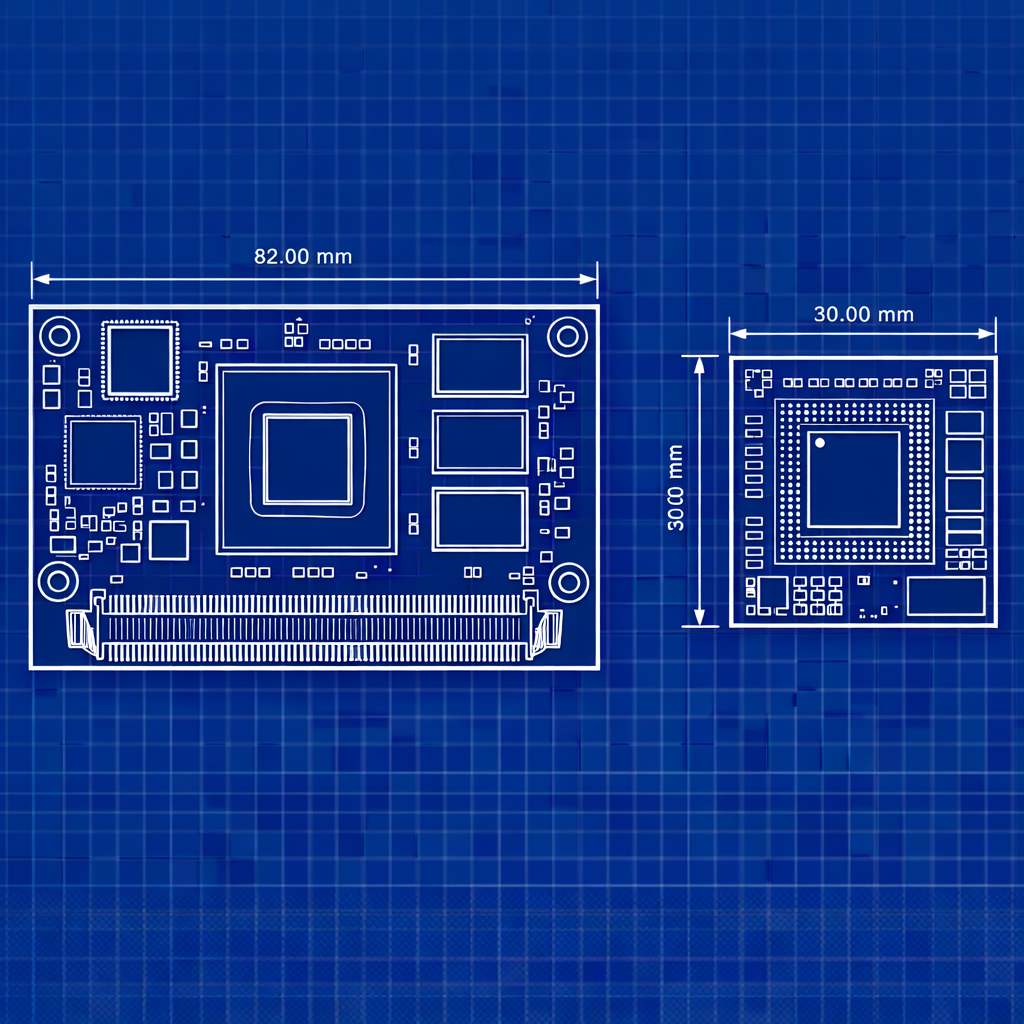
SMARC is maintained by the SGET (Standardization Group for Embedded Technologies) and is currently at version 2.1.1, ratified in 2024. The specification defines a module measuring 82 mm × 50 mm (full size) or 82 mm × 30 mm (short size), with a 314-pin edge connector using a 0.5 mm pitch MXM-style interface. It was originally designed with mobile and automotive applications in mind — "Smart Mobility ARChitecture" — which explains its emphasis on display interfaces, camera buses, and power management flexibility.
SMARC 2.1 added standardized support for PCIe Gen 3, extended the USB 3.0 signal definitions, and formalized the MIPI CSI-2 camera interface lanes. The SMARC 2.1.1 addendum "gives designers freedom with regards to SerDes signaling over PCIe for Gb Ethernet, as well as full USB-C support offering USB 3.2 Gen1 and DisplayPort Alt Mode over one single USB interface." The specification is explicitly silicon-agnostic: it supports ARM Cortex-A class processors and x86 designs from any vendor. Signal definitions for HDMI, LVDS, MIPI DSI, and dual Gigabit Ethernet make SMARC a strong fit for any application that needs display output or rich connectivity as a baseline.
Ezurio's SMARC modules leverage chipsets from both NXP (i.MX 91, i.MX93, i.MX 95, i.MX 8M Plus, and i.MX 8M Mini) and MediaTek (Genio 510, Genio 700). Ezurio's roadmap includes an evolving product line as new chipsets become available for our partners, giving our customers an upgrade path for the future.
The MXM connector handles power delivery, high-speed differential signals, and low-speed I/O on the same connector block. This is efficient from a module footprint standpoint but introduces routing complexity on the carrier: the MXM's fine pitch demands controlled impedance on high-speed lanes and careful signal segregation to prevent interference between USB 3.0 and PCIe lanes and adjacent lower-speed signals.
OSM (Open Standard Module)
OSM is the newer standard, also maintained by SGET, with version 1.1 published in 2020 and version 1.1 Rev B in active use. OSM was explicitly designed as the successor form factor for applications where SMARC is physically too large, and it defines three sizes: S (30 mm × 30 mm), M (45 mm × 30 mm), and L (45 mm × 45 mm). The connector is a land grid array (LGA) — the module solders directly to the carrier board at 0.8 mm pitch, like a large BGA component.
The philosophical difference is significant: OSM treats the module as a soldered component, not a replaceable daughterboard. The LGA attachment is permanent in normal assembly. There is no connector to unseat, no mechanical cycling, and no connector insertion force specification to manage. The tradeoff is that field replacement of an OSM module requires rework — reflowing the module off the carrier board — which is straightforward in a manufacturing environment but impractical in the field without specialized equipment.
Ezurio's OSM modules leverage chipsets from both NXP(i.MX 91) and MediaTek (AM62, AM62L, and AM67), with the same plan to continue to expand offerings for a future upgrade path for our customers.
OSM's signal set reflects its embedded-first focus. GPIO, UART, SPI, I2C, and single-channel USB are the baseline I/O types. PCIe is optional and present only on M and L sizes. Display interfaces are limited relative to SMARC. What OSM prioritizes instead is a minimal, clean signal footprint that supports simpler carrier board design — fewer high-speed differential pairs to route, lower layer count requirements, and more forgiving impedance tolerances.