Vendor Lock-In in SOM Selection

Why Ezurio built EZ BSP on open source foundations and what that means for your product roadmap

Published on July 1, 2026

Vendor Lock-In in SOM Selection

Most engineers think about vendor lock-in at the hardware level. You pick a SOM, you're committed to that form factor, that silicon family, that vendor's supply chain. That's a real decision and it deserves careful thought. But there's a second layer of lock-in that doesn't get nearly enough attention during the design phase, the software stack. 

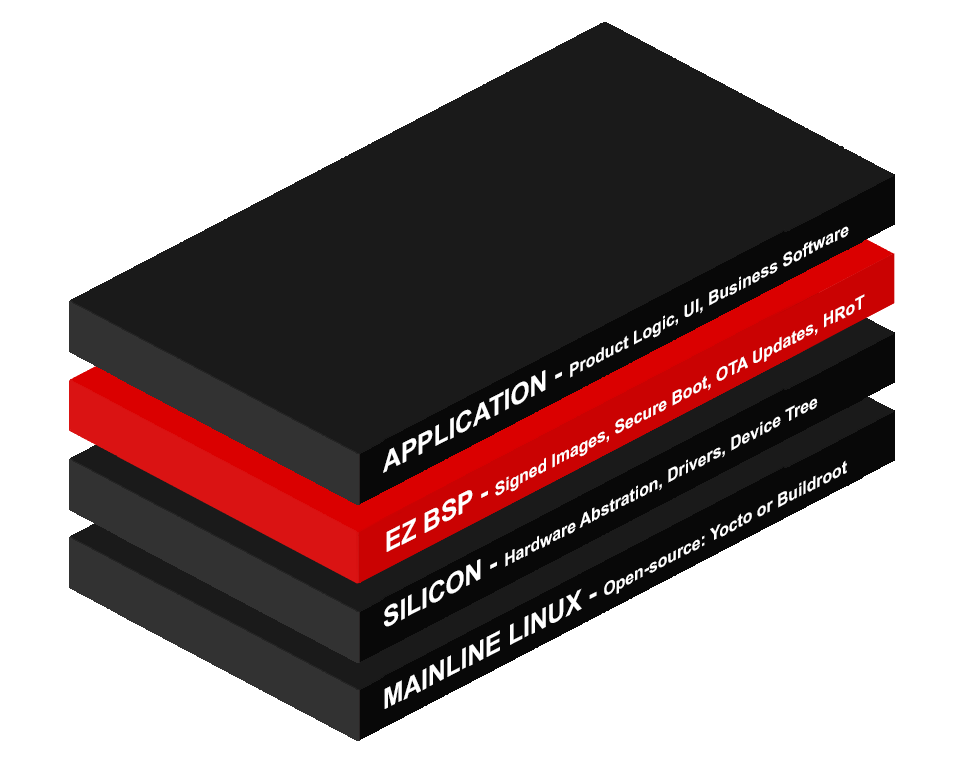
Sitting between the application and the hardware is where your BSP lives. And unlike the hardware decision, which is deliberate, BSP lock-in tends to accumulate quietly through proprietary driver dependencies, kernel version constraints, closed-source tooling, and security architectures that can't be fully inspected or maintained. 

This blog is about how Ezurio approached that problem when building EZ BSP, and why the choices we made matter for engineering teams evaluating SOM platforms.

Same Silicon, Different Story

Take NXP i.MX 95. Multiple SOM vendors build on it; the silicon is the same. When you're evaluating options, the differentiator isn't the processor, but it's everything that runs on top of it. A typical competitor BSP on i.MX 95 gives you a Yocto layer, a connectivity driver, and enough to get booted. What you don't get is:

  • A driver that tracks kernel API changes as your product evolves
  • A full software stack that's been QA tested as a unit
  • Regulatory firmware management that doesn't require going back to the vendor for every update
  • A security architecture that doesn't depend on proprietary tooling to maintain

Why Ezurio Built on Open Source

EZ BSP is built entirely on open source foundations: Linux kernel, U-Boot, Yocto, Buildroot. The driver code is on public GitHub under Apache 2.0 and GPL2 licenses.

Your Kernel Roadmap is Yours

The EZ Connectivity Stack supports 75+ kernel versions, from v2.6 through v6.18+, from a single driver source. That's the broadest kernel version support in the industry. It means when you need to move to a newer kernel, for security fixes, new hardware support, you're not blocked waiting for a driver port. The backports infrastructure handles that. Your kernel upgrade decision is driven by your product needs and not by what the connectivity vendor supports.

Your Engineers Build Transferable Skills

When your team learns to work with EZ BSP, they're learning Yocto and Buildroot which are used across the embedded Linux world. They're not learning a proprietary layer that only works inside one vendor's ecosystem. When an engineer on your team moves to a new project, or a new hire joins, that knowledge transfers. You're not accumulating institutional debt in the form of tooling expertise.

You Can Inspect and Understand Everything

All driver code is on public GitHub. The build system is Yocto or Buildroot and your team can read every layer and configuration without any black box component that cannot be verified. This is especially important for anyone working in regulatory compliance.

Regulatory Updates Don't Require a Vendor Call

The LRU (License-free Regulatory Update) tool lets you update regulatory domain settings without a new firmware image and without a license fee. Regulatory requirements change and markets evolve. Being able to handle that without a vendor dependency is a real competitive advantage when products are spread out across multiple regions.
Not all Software Stacks Are The Same

Benefit Ezurio: EZ BSP Stack Competitor: Minimal Driver Support Competitor: Closed Source
Open-Source License Yes Yes No
Multiple Build Environments (Buildroot, Yocto, Android, Ubuntu) Yes No Optional
Multiple Kernel Versions Supported Yes (75+) No No
Full Stack QA Tested Yes No No
Actively Maintained Yes No Paid
License-Free Regulatory Tools Yes No No
Module Partner Supported Yes No Yes
Free Yes Yes No
Public GIT access Yes No No

What This Means At Design Time

The time to think about BSP lock-in is before you've committed to a platform. A few questions worth asking when evaluating any SOM platform on your target silicon:

  1. What build systems are supported and are they industry standard?
  2. How many kernel versions does the connectivity driver support, and what happens when you need to move to a newer one?
  3. Is the full stack (drivers, firmware, supplicant, network manager) QA tested together, or are you the integration test?
  4. Can your team update regulatory domains without going back to the vendor?
  5. Is the driver code publicly accessible and open source, or are there proprietary components you can't inspect?


EZ BSP is our answer to all of those questions. It's built on open source foundations because we think that's the right architecture for products that need to be maintained for years and engineering teams deserve a software stack they can actually understand, modify, and own. 

Choosing a SOM vendor means accepting some level of hardware commitment. EZ BSP is built specifically to avoid that second layer. Open source foundations, 75+ kernel versions from a single maintained source, full-stack QA, and license-free regulatory tooling. The goal is that when you choose Ezurio hardware, your software investment stays yours.

To learn more about EZ BSP, visit: www.ezurio.com/ez-bsp