What Makes our EZ BSP for Linux Unique?

Every embedded Linux platform — System-on-Modules (SOMs) and Single-Board Computers (SBCs) alike — requires a Board Support Package (BSP). It’s what generates the Linux OS that boots and runs on the module and its carrier board: U-Boot, the Linux kernel, the device trees that describe the hardware, and the drivers that bring it up. But our EZ BSP for Linux goes many steps further, enabling features and functionality that are game changers for our customers.

By Dan Kephart

Published on August 31, 2026

At a bare minimum, SOM and SBC vendors must provide the basic tools customers need to boot Linux on their new design and get it talking to their carrier board. This is commonly known as a board support package (BSP), and it’s a necessary and fundamental software offering. What makes up a board support package greatly varies by vendor, but at minimum a Linux BSP must deliver:

  1. A build system — a Yocto layer or Buildroot external tree that assembles the OS reproducibly
  2. U-Boot — a bootloader port for the module, with boot parameters and boot-media configuration
  3. The Linux kernel — a version carrying the silicon vendor’s patches, with a defconfig for the module
  4. Device trees — describing the SOM or SBC and its carrier board so Linux can find the hardware
  5. Drivers — for the on-module peripherals and the carrier-board interfaces you designed against

A BSP is highly specialized, with vendors tailoring it to the specific combination of silicon, module design, and Linux build system they ship. The level of feature support that vendors provide out of the box is variable as well; some vendors provide a fairly blank slate, forwarding the silicon vendor’s reference Linux BSP with little more than a device tree for their own module and doing very limited development on top of that. Sometimes that’s all a customer really wants, but more often than not this leaves designers on the hook to develop some of the most important functionality entirely by themselves. This includes implementing an OTA update mechanism, building a security strategy, satisfying regulatory requirements, and much more. For small teams, this can be a non-starter and plunge development into the deep end from the start. 

By contrast, Ezurio offers the EZ BSP as a full culmination of our decades of experience building embedded Linux for wireless SOMs and SBCs. Our development is closely tied to the needs and expectations of our customer base, and so we are uniquely positioned to anticipate issues and provide solutions out of the box. That includes support for features like OTA updates, complete chain of trust device security, assistance with device secrets and secure manufacturing, a robust Yocto and Buildroot release schedule backed by full-stack QA testing on every module, and much more. 

In this post we’ll examine this offering in greater detail to explain what EZ BSP for Linux offers that other SOM and SBC vendors don’t, and how these inclusions simplify our customers’ lives and allow smaller teams to do more than ever before.

Layers on Layers: How EZ BSP Stacks Up

As we previously mentioned, different SOM and SBC vendors offer very different levels of feature support in their Linux BSPs. Ezurio customers receive much more, at a time when regulatory requirements are increasing and so are customer expectations. In the EU, the creation of the Cyber Resilience Act means a security update plan is not just a nice feature to have, it’s a legal requirement[EB1.1]. And elsewhere, it’s become an expected norm for device users and administrators across industries. 

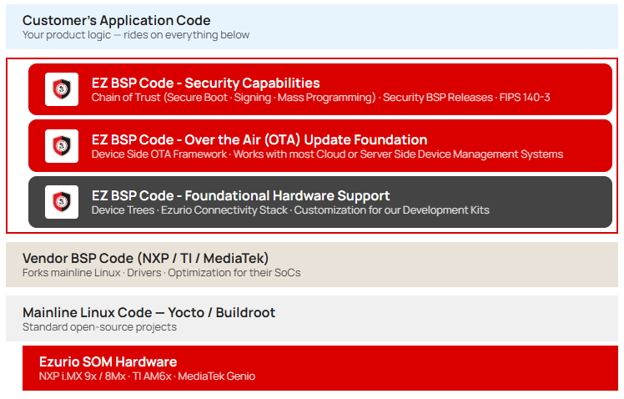
Our Linux BSP — in Yocto or Buildroot — is the foundation of your software bill of materials and of every tool we layer on top of it. We start with the silicon vendor’s BSP code — NXP, TI, or MediaTek — which gives us a U-Boot port, a mainline Linux kernel with their patches, device drivers, and optimizations for their chipset. Everything above that line is EZ BSP. 

EZ BSP - Stack.png

On top of the vendor BSP code is what we call EZ BSP. 

  • Foundational Hardware Support: This is the first layer of our improvements above mainline Linux and SoC vendor drivers. Device Trees custom to our Ezurio hardware live here, as well as our Ezurio Connectivity Stack. Also here is support  for our fully-featured  EVKs, our hardware offerings that expose everything you need for initial product development. 
  • Over the Air (OTA) Update Foundation: This second layer is made of the tools and mechanisms to do secure updates to your devices in the field. It’s incredibly powerful and extensible to most device management systems, built on SWUpdate, the most common OTA engine in embedded Linux, with support for most cloud and server firmware update backends. 
  • Security Capabilities: This third layer is the full foundation for the EZ BSP security offering, with implications for the entire device from the bootloader through into user space. Our Chain of Trust architecture ensures that ONLY your software runs on your device. It begins with processor hardware root of trust, which validates the signed bootloader, which validates the signed Linux kernel and applications on a read-only verified filesystem, and includes a secure enclave for your private keys and encryption for your business data. At every step trust is verified, and this process can further be extended into your production process with per-customer keys and certificates provisioned on our manufacturing line, signed through an AWS-backed service so no one — at Ezurio or at your company — handles the private key. [DD3.1][DK3.2][DK3.3]Furthermore, EZ BSP supports our FIPS 140-3 Level 1 validated cryptographic modules for Wi-Fi and TLS data-in-transit, shipping today on the 60 Series SOM. 

The EZ BSP foundation is standard on every Ezurio SOM and SBC.The security capabilities on top are optional, so you take only what your end product requires — with software or tooling, and no vendor lock-in. We provide these customizations on top of already excellent and trusted open-source software because we understand what’s needed to compete in today’s embedded design marketplace and can extend our experience to our customers. 

Next, let’s discuss the benefits of those tools we offer in EZ BSP, and the additional features and functionality that they extend to our customers. 

A Baseline for Crucial Feature Enablement

The above are the core components of EZ BSP that enable the rest of what we offer to customers. Think of them as the dependencies that unlock a full security strategy, expanded wireless feature set, software updates, a pipeline for SBOM output that feeds into your CVE platform, and much more. With EZ BSP, the foundational blocks are already in place to tackle the bigger challenges that go beyond the scope of your core application. It’s the jump start that teams need to go beyond their application and develop scalable lifecycle management and security. 

Again, the silicon vendor’s BSP typically only provides the materials needed to get your hardware up and running. But by leveraging EZ BSP, you’re provided on day one with the tools to protect the integrity of every bit of software running on your device. You get access to the tooling to establish trusted keys on the device in manufacturing, in deployment, and in the field for the long term. And you get access not only to LTS Linux releases for bug, stability, and feature updates, but also the means to deploy and validate them in the field with A/B data banks. 

The inclusion of our EZ Connectivity Stack into EZ BSP also means that customers using our wireless-enabled SOMs get access to some of our industry-unique features that are major differentiators to our customers. With EZ Connectivity Stack comes enablement of features like Adaptive Worldwide Mode (AWM), which allows customers to ship a single SKU that intelligently adapts to the channel set requirements of the local environment. Our development on top of the open-source fork of NetworkManager gives customers fine-tuned control over their wireless connection, scanning and roaming, and security features that are unavailable in the mainline Linux NetworkManager. Furthermore, with our extensively QA tested Kernel Backports package (tested for 70+ Linux kernel versions), you’re never forced into a particular kernel to support the wireless piece. Our EZ Connectivity Stack is fully tested, all components evaluated together, so you never have to worry about an individual update breaking your whole implementation.

Taken together, EZ BSP is not just a set of software capabilities, it is a roadmap to the modernized and regulatory-compliant embedded compute lifecycle. No other vendor provides a board support package like it: fully built on open source, with complete hardware root of trust readiness, with FIPS cryptography for sensitive applications, and with software update and SBOM tools to protect your device in the field for decades. 

Learn more about EZ BSP on our website: 

https://www.ezurio.com/software/ez-bsp 


Learn more on these topics: